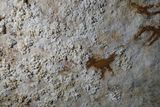
A recent study has identified rock art in Sulawesi, Indonesia, as the oldest known example of its kind, dating back approximately 67,800 years. This remarkable discovery, published in the journal Nature, suggests that the art may provide insights into the movements of early human populations, potentially linking them to the ancestors of modern Aboriginal Australians.
The art consists of a faint stencil resembling a human hand, found in the Liang Metanduno cave on the island of Muna. According to Maxime Aubert, a researcher at the Griffith Centre for Social and Cultural Research, this finding underscores the significance of Sulawesi as a site of rich artistic heritage. Aubert stated, “It is now evident from our new phase of research that Sulawesi was home to one of the world’s richest and most longstanding artistic cultures, one with origins in the earliest history of human occupation of the island.”
Sulawesi has long been recognized as a crucial location in human history, serving as a canvas for some of the earliest expressions of art. Previous studies have also identified ancient cave paintings depicting human and animal figures, suggesting a vibrant artistic tradition. The recent research focused on various rock art sites, revealing multiple stencils, including the claw-like hand outline, which researchers believe were created by early H. sapiens artists.
Utilizing advanced techniques such as uranium-series dating and mineral deposit analysis, the research team determined that the stencil predates previously known rock art in the region by approximately 16,600 years. The findings indicated that the creators of this art were likely part of the broader population that migrated through the region. Adhi Agus Oktaviana from Indonesia’s National Research and Innovation Agency remarked, “This discovery strongly supports the idea that the ancestors of the First Australians were in Sahul by 65,000 years ago.”
The archipelago of Sahul, which once connected Australia, New Guinea, and Tasmania, is believed to have played a pivotal role in the migration of early humans from Asia. The study suggests that Sulawesi may have served as a stepping stone for these migrations, with researchers noting that the Liang Metanduno cave also contains younger paintings, indicating a long period of human occupation.
Prior research had proposed two timelines for the arrival of H. sapiens in Sahul: the “long chronology” around 65,000 years ago and the “short chronology” around 50,000 years ago. These studies posited two possible migration routes—one through Sulawesi and another through Timor—leading to the eventual settlement of the New Guinean and Australian regions.
With these findings, Renaud Joannes-Boyau from Southern Cross University stated, “With the dating of this extremely ancient rock art in Sulawesi, we now have the oldest direct evidence for the presence of modern humans along this northern migration corridor into Sahul.” The team expressed their intent to continue exploring sites along this route, emphasizing the archaeological significance of other Indonesian islands as potential locations for further discoveries.
Overall, the research highlights the importance of Sulawesi not only as a cultural hub but also as a key site in understanding human migration patterns. As Aubert noted, the ongoing exploration of this region could uncover more evidence about the artistic and migratory practices of our ancient ancestors.