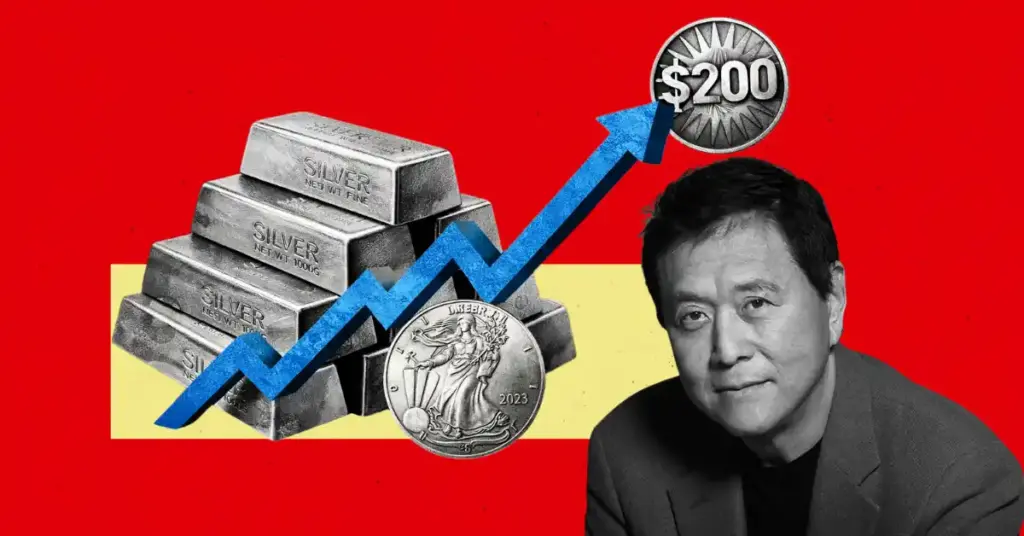
Silver has captured attention as its price approaches record highs, with predictions of significant future growth. Author of the bestselling book Rich Dad Poor Dad, Robert Kiyosaki, has announced that he believes silver could reach $200 per ounce by 2026. Kiyosaki emphasizes silver’s essential role in the modern technology economy, suggesting it has advantages over gold due to its extensive industrial applications.
As of now, silver has hit a high of $95.89, reflecting a 31% increase year-to-date. This upward trajectory has sparked discussions among market analysts, some of whom believe the rally could continue, while others question if the market is nearing a peak.
Kiyosaki’s Perspective on Silver’s Value
Kiyosaki’s argument hinges on silver’s functional utility compared to gold. He points out that while gold is often stored in vaults, silver is actively used in a variety of applications, including electronics, solar panels, electric vehicles, medical devices, and military equipment. Much of silver’s supply is consumed in these processes and is not easily recyclable.
“In today’s Technology Age, silver is elevated into an economic structural metal, much like iron was the structural metal of the Industrial Age,” Kiyosaki stated. He references silver’s historical price, noting that in 1990, it traded at around $5 per ounce, reinforcing his belief in its increasing significance in a technology-driven economy.
Market Analysis and Future Projections
Kiyosaki’s prediction of $200 per ounce is not the most ambitious forecast circulating among market analysts. Some experts suggest silver could reach as high as $300 by 2026. One particular analysis draws comparisons between silver’s current price and the total U.S. money supply, indicating that investing in silver now is akin to purchasing it in 1972.
To illustrate the potential for growth, if silver were to match its all-time high from 1980 relative to the dollars in circulation, it would need to soar to $1,630 per ounce. Additionally, compared to the Dow Jones, silver is trading at levels reminiscent of the early 2000s, when its price was under $6 and considered undervalued.
Despite his optimistic outlook, Kiyosaki offers a cautionary note. He acknowledges the volatility of silver prices and the possibility of a decrease in industrial demand during economic downturns. Moreover, he highlights the risk of new supply sources or alternative materials emerging in the market.
In summary, with silver prices at record highs and growing momentum, the market is watching closely. Kiyosaki’s insights contribute to a broader conversation about the future of silver and its potential role in the evolving economic landscape.