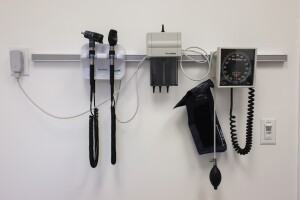
Medical instruments in an exam room at Prism Health South Dallas Health Center.
Nearly 800 patients in Texas state hospitals have been admitted for more than a year, creating significant challenges for mental health service capacity. According to data shared on Wednesday, almost 40% of the nearly 2,000 patients currently in state-operated facilities, which include ten hospitals and one youth residential treatment center, fall into the category of “365-plus,” meaning they have been hospitalized for over a year.
Vinay Vuriti, a data analyst for the Offices of Forensic Services and Coordination, reported to the Joint Committee on Access and Forensic Services that the average length of stay for these patients is alarming, averaging 1,591 days, or over four years. This extended duration of hospitalization restricts the capacity for new patients, resulting in a growing waitlist for services. Windy Johnson, a committee member and representative of the Texas Conference of Urban Counties, emphasized the impact of these long stays. “A lot of people have been there for three years, which obviously delays a new person getting into the state hospitals,” she stated.
The committee has made efforts to address the waitlist issue, which peaked in fiscal year 2023 with over 1,000 people awaiting placement in Texas state maximum security units. Since then, the waitlist has decreased to about half. For non-maximum security unit beds, the average waitlist dropped from approximately 1,400 in 2023 to around 1,200 in 2024, although it has seen fluctuations since then.
Despite these improvements, several barriers remain in opening up additional beds in state hospitals. Vuriti noted that more than 250 long-stay patients are deemed “ready for discharge” by their treatment teams but have not been released. Most of these long-term patients are classified as forensic patients, meaning their hospital stays are tied to the legal system. Discharge requires authorization from a judge, but various factors can influence the length of stay beyond judicial determinations.
Dr. Jeffery Matthews, the Chief Medical Officer for Texas state hospitals, has introduced patient discharge needs forms to identify obstacles preventing patients from leaving. He raised critical questions regarding the specific needs of these individuals. “What do these individuals need?” he asked. “What living setting would be appropriate for them? What clinical considerations should we take into account? What medical considerations?”
Another challenge faced by the state hospitals is the lack of available placements for discharged patients. Matthews pointed out that many individuals may not have a caregiver or adequate insurance coverage to support their transition back into the community. According to patient discharge needs assessments conducted in December, approximately one-third of patients did not require continued hospitalization, as there were adequate support and monitoring options available outside of the hospital setting. “If we could start looking at these barriers to discharges, we could help people transition out of the hospital,” Matthews noted.
In recent years, the state has expanded the number of beds in its hospitals and is in the process of constructing new facilities to increase capacity, including the first state hospital in the Dallas-Fort Worth Metroplex. State officials are also working on a comprehensive long-term plan for state hospitals, with a public comment session scheduled for February 2, 2024.
Johnson emphasized the importance of a holistic approach to the planning process. “If we don’t have anywhere to discharge people that have been sitting in a state hospital,” she cautioned, “then the waitlist is not going to reduce in a timely fashion.”
The ongoing situation highlights the urgent need for systemic changes in Texas’s mental health care framework to ensure timely access to services for all individuals in need.