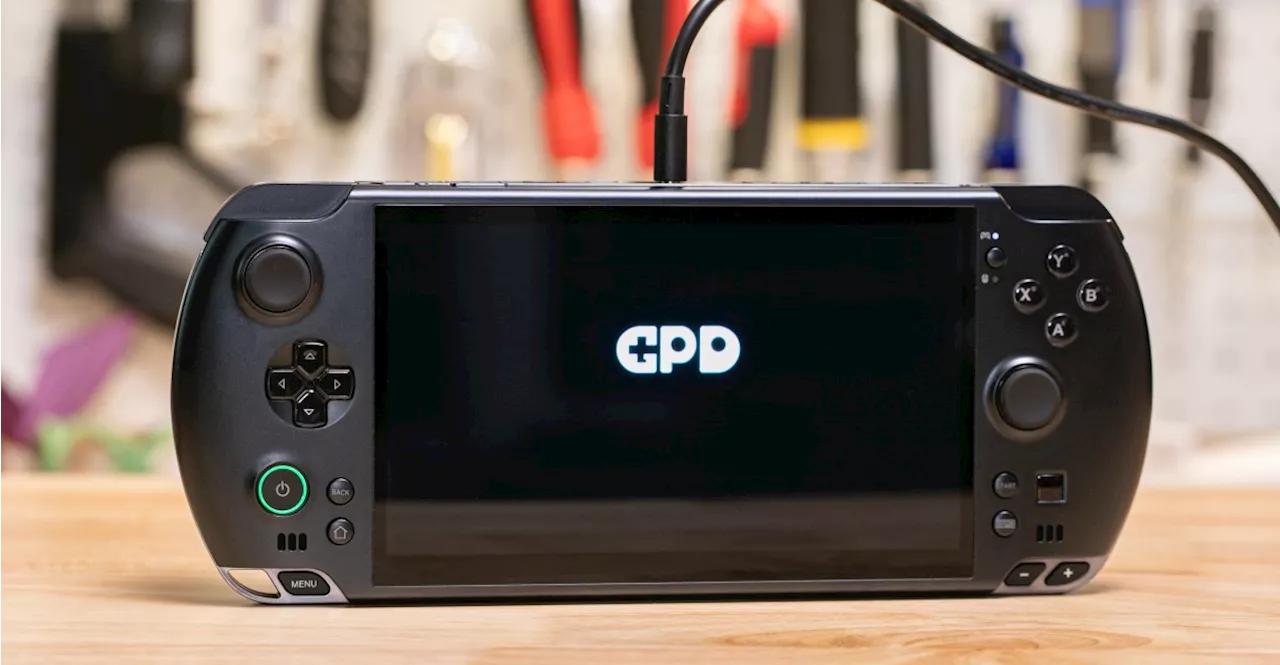
The GPD Win 5 has entered the handheld gaming market, featuring the first AMD Strix Halo chip, a significant advancement in portable gaming technology. This device, however, deviates from traditional handheld designs by requiring users to keep it plugged into a power source or use an external battery pack at all times. With prices ranging from $1,600 to $2,200, the Win 5 is aimed at serious gamers seeking high performance rather than portability.
The GPD Win 5 boasts a 7-inch, 1080p, 120Hz VRR display, resembling an oversized PlayStation Vita with its sleek design and comfortable controls. One of its standout features is its D-pad, which has received praise for its responsiveness and comfort. The device’s appeal lies primarily in its processing power, driven by the AMD Strix Halo chip, which offers the fastest integrated gaming graphics currently available.
To harness the potential of this powerful chip, the GPD Win 5 requires either a constant power connection or a removable battery pack. This design choice raises questions about the practicality of the device for on-the-go gaming. Initial concerns about the need for a power source were eased during testing, which revealed that GPD had carefully considered the implications of a corded handheld.
While playing with an early prototype, the experience proved more manageable than anticipated. Users can connect the battery pack and detach the power cord while still maintaining high frame rates, or they can strategically place the battery in a pocket to alleviate weight concerns. Unlike ordinary USB-C batteries, the Win 5’s connections allow for greater power delivery, facilitating significantly enhanced gaming performance.
Despite the advancements in handheld gaming, the market has seen limited evolution since the launch of the Steam Deck over three years ago. While other manufacturers have introduced faster chips, none have matched the Steam Deck’s capability to play modern games at 1080p resolution. The GPD Win 5 addresses this gap, demonstrating its ability to run demanding titles like Cyberpunk 2077 and Shadow of the Tomb Raider at over 60 frames per second on ultra settings, without relying on AI-enhanced upscaling.
Power consumption emerges as a critical factor for the GPD Win 5, as its Strix Halo chip can draw up to 60 watts when on battery. When plugged into the provided AC adapter, the device can utilize up to 80 watts, leading to impressive performance metrics. However, this high power usage results in rapid battery drain, limiting off-grid playtime to about 45 minutes under heavy use. In contrast, the Steam Deck operates on a maximum of 15 watts, with competitors like the MSI Claw 8 and Lenovo Legion Go 2 utilizing 30 to 35 watts.
For users who prefer longer play sessions, GPD offers fine control over power settings, allowing the Strix Halo chip to operate at a reduced 6-watt TDP, potentially extending battery life beyond six hours for less demanding games. Comparatively, the Win 5 outperforms rivals in short bursts while suffering in longer gaming sessions unless plugged in.
The GPD Win 5 remains a prototype, with ongoing development to address several technical issues encountered during testing. Users experienced system hangs and other bugs, highlighting the challenges faced by a smaller company like GPD, which often relies on crowdfunding platforms such as Indiegogo for product launches.
Despite the initial concerns, the GPD Win 5 presents exciting possibilities for the handheld gaming market. With a solid D-pad, responsive controls, and the potential for high performance, it positions itself as a powerful option for dedicated gamers. As GPD refines the device, it holds the promise of expanding the boundaries of handheld gaming.