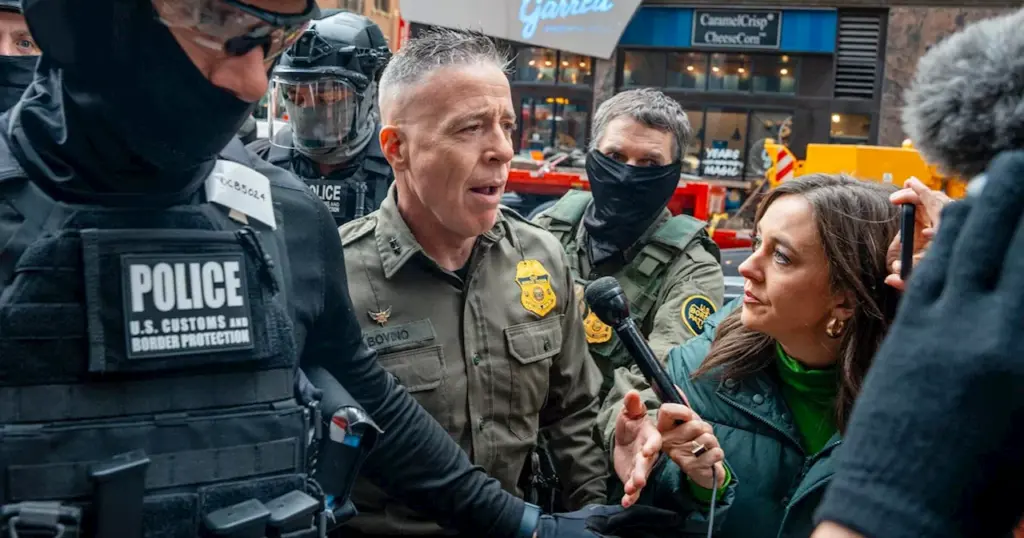
Journalists from the Chicago Headline Club have taken steps to ensure that the same federal judge who granted them a preliminary injunction against the U.S. Department of Homeland Security (DHS) will oversee a new lawsuit filed by the State of Illinois and the City of Chicago. This latest suit challenges the Trump administration’s practices regarding the use of force by federal agents during immigration enforcement operations.
In a motion submitted to the U.S. District Court for Northern Illinois, the plaintiffs argue for the reassignment of the case to Judge Sara Ellis, citing significant overlap in both factual and legal matters between their case and the state’s lawsuit. The journalists contend that both cases involve serious allegations concerning the excessive use of force against Illinois residents, as well as unlawful warrantless arrests.
The Chicago Headline Club’s case, Chicago Headline Club v. Noem, includes key defendants such as DHS, Immigration and Customs Enforcement (ICE), and Customs and Border Protection (CBP), many of whom are also named in the Illinois lawsuit. The state’s legal action, filed in the same court, asserts that federal agents employed illegal tactics during a two-month operation known as Operation Midway Blitz.
Judge Ellis recently declined to dismiss the journalists’ lawsuit, a decision influenced by serious concerns regarding the shooting death of U.S. citizen Renee Nicole Good by an ICE agent in Minneapolis. She noted, “If I dismiss this case, the preliminary injunction ceases to exist. Given my ruling, I believe that the evidence presented justifies the need for a preliminary injunction to govern the actions of federal agents when interacting with legal observers, journalists, and protesters.”
In her ruling, Ellis issued an injunction that limits the use of force by federal officers unless absolutely necessary. She emphasized that the aggressive tactics used against peaceful protesters in Chicago were shocking and that the testimony provided by the Trump administration regarding the necessity of such force was not credible. She specifically referred to instances where federal agents, including a named defendant, had lied about the threats posed by protesters.
The Chicago Headline Club is slated to have a hearing regarding their motion on January 22. This hearing could prove pivotal as the journalists seek to continue their fight against what they describe as unlawful actions by federal agents.
The Illinois lawsuit aims to halt operations by ICE and CBP in the state, declare their enforcement surge unconstitutional, and enforce changes in agent conduct. The actions taken by the Chicago Headline Club and the state reflect an ongoing tension between federal enforcement practices and local governance, highlighting the complex dynamics of law enforcement in the context of immigration.
As legal proceedings unfold, the implications for both the journalists and the broader public remain significant. The outcomes not only impact the individuals involved but also set precedents for the treatment of journalists and legal observers during federal operations.