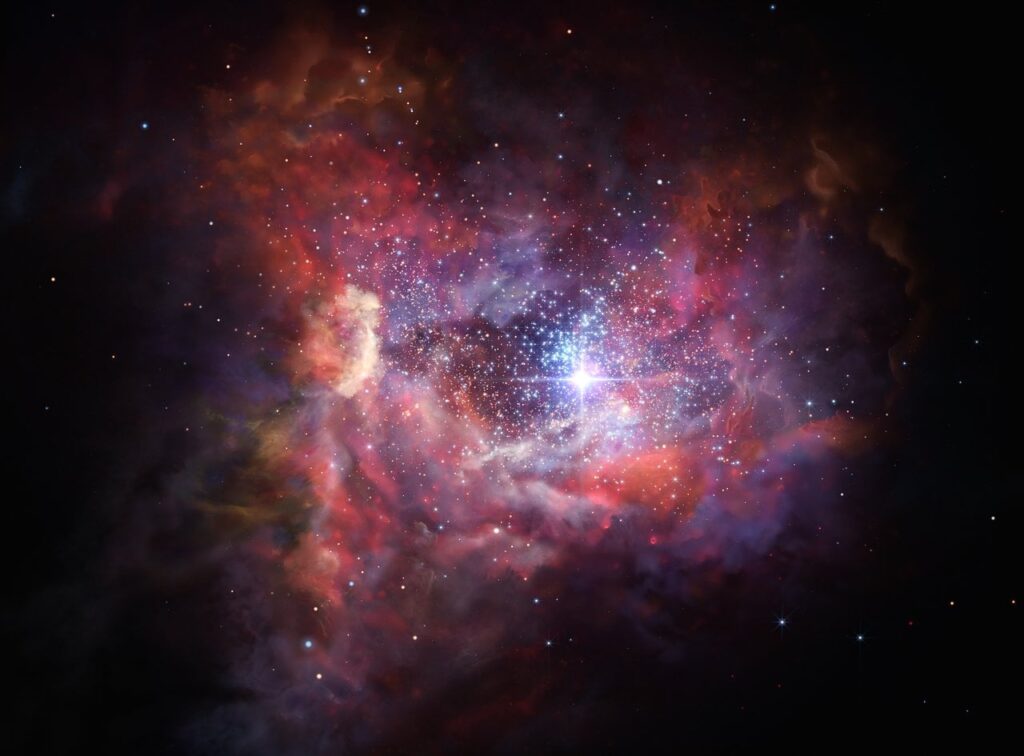
A recent study presented at the American Astronomical Society Meeting reveals that early galaxies evolved at a pace faster than previously anticipated. Led by Andreas Faisst of Caltech, this research, published in The Astrophysical Journal Supplement, examined eighteen galaxies from a period approximately 12.5 billion years ago during the universe’s formative stages.
Researchers combined data from various telescopes, including the James Webb Space Telescope (JWST), the Hubble Space Telescope, and the Atacama Large Millimeter Array to gather insights across different wavelengths. This multifaceted approach allowed scientists to capture unique features of these distant galaxies. The findings challenge existing models of galaxy evolution, particularly regarding the accumulation of metals—elements other than hydrogen and helium crucial for the formation of planetary systems.
The study indicates that these early galaxies, previously considered metal-poor, show a surprising level of metallicity. This suggests that they were capable of converting hydrogen and helium into heavier elements more quickly than expected. Notably, there was minimal difference in metallicity between galaxies from the Post-Reionization epoch (1-1.5 billion years after the Big Bang) and those from the subsequent Cosmic Noon epoch.
Active Galactic Nuclei and Star Formation Patterns
Additionally, the research uncovered a significant presence of Active Galactic Nuclei (AGN) within these galaxies. AGNs are regions surrounding supermassive black holes that are actively consuming gas and dust. The JWST has detected numerous AGNs in the early universe, leading astronomers to consider these phenomena as common features in star-forming galaxies during the Post-Reionization epoch. The selected galaxies for this study did not initially exhibit obvious AGN signatures, which allowed for more focused observations across different wavelengths.
The paper also highlights a bursty pattern of star formation in these early galaxies. Researchers found that these galaxies either experienced rapid star formation or very little activity at all. This variability can be tracked using different indicators, such as the H-alpha line, which measures star formation over the past 10 million years, and ultraviolet/infrared spectra that cover a broader 100 million-year timeframe. Discrepancies between these indicators illustrate the intermittent nature of star formation in these galaxies.
This research is part of a larger series that aims to explore various aspects of early galaxies, including their rotation and metal gradients. The findings underscore the importance of examining a wide array of spectral data to deepen our understanding of galaxy evolution.
As telescope technology continues to advance, astronomers anticipate uncovering even more about these distant cosmic formations. The ongoing exploration of early galaxies holds the promise of revealing critical insights into the universe’s history and the processes that shaped it.