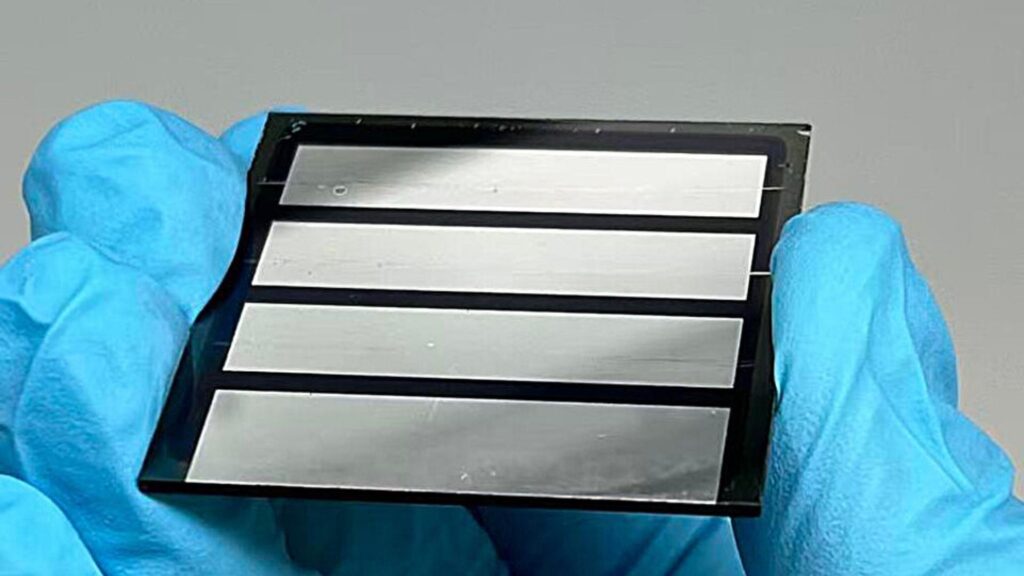
Researchers at the University of Manchester have made significant strides in solar technology by developing a new type of perovskite solar cell that maintains over 95% of its performance after extensive testing. Led by Professor Thomas Anthopoulos, the team has created a stabilization method that addresses the critical issue of material degradation, which has long hindered the widespread adoption of this promising technology. The findings were published on January 8, 2025, in the journal Science.
Advancements in Solar Cell Technology
The newly designed perovskite solar cells achieved a remarkable power conversion efficiency of 25.4% during testing. These cells are not only efficient but also resilient, withstanding extreme temperatures that would typically compromise older models. Previous iterations of perovskite solar cells were notorious for their rapid degradation, often becoming unusable within days when exposed to heat and light. This latest development, however, could pave the way for broader commercial use of the technology.
Silicon has dominated the solar market for decades due to its reliability, but it comes with significant drawbacks: it is heavy, rigid, and expensive to produce. In contrast, perovskite solar cells are lightweight, flexible, and potentially more affordable. Yet, their early versions faced challenges related to stability, with microscopic flaws leading to energy leakage that conventional diagnostic tools struggled to detect.
“Current state-of-the-art perovskite materials are known to be unstable under heat or light, causing the cells to degrade faster,” noted Professor Anthopoulos. These hidden defects hinder electricity flow and accelerate material breakdown, which has stalled the technology’s path to real-world applications.
Innovative Solutions to Long-standing Issues
The research team tackled these challenges by employing small-molecule ligands that act as a form of “molecular glue.” This innovative approach smoothes the surface of the perovskite, effectively sealing microscopic defects and enhancing structural stability. This chemical bond allows the perovskite material to organize into stable, low-dimensional layers, forming a protective barrier that significantly improves energy flow and thermal resistance.
In practical terms, the stabilized solar cells retained over 95% of their performance after 1,100 hours of continuous operation at 85°C (or 185°F), a temperature at which previous models would have likely failed. Such durability opens the door for perovskite technology to be used in a variety of applications beyond traditional solar panels.
“Perovskite solar cells are seen as a cheaper, lightweight, and flexible alternative to traditional silicon panels, but they have faced challenges with long-term stability,” Professor Anthopoulos explained. “The ligands we’ve developed, along with the new knowledge gained, enable the controlled growth of high-quality, stable perovskite layers.” This advancement could resolve one of the last major obstacles facing perovskite solar cell technology.
Furthermore, the versatility of this technology could revolutionize renewable energy usage by allowing perovskite solar cells to be printed onto flexible surfaces, including curved windows, lightweight camping gear, and even clothing fabrics. As the race to commercialize perovskite technology accelerates, the implications for sustainable energy solutions become increasingly significant.
In related developments, researchers in China have introduced a three-dimensional electrical imaging method that provides a detailed view of charge-carrier migration in perovskite films, enhancing the understanding of internal electrical behavior. This imaging technique may help identify and rectify hidden defects, further boosting material performance and stability.
The progress made by the University of Manchester represents a promising shift in the solar energy landscape, potentially leading to broader adoption of perovskite technology in the near future.