NASA has decided to bring four astronauts back to Earth earlier than planned due to a medical issue affecting one crew member aboard the International Space Station (ISS). Commander Mike Fincke announced on social media that he and his crewmates are stable and well cared for, describing the decision to return as “bittersweet.”
In a post on LinkedIn, Fincke, 58, expressed gratitude to NASA for prioritizing crew health. He stated that alongside Crew 11 commander Zena Cardman, Japanese astronaut Kimiya Yui, and Russian cosmonaut Oleg Platonov, they are “all OK.” The crew was initially scheduled to return around February 20, 2024, but will now undock from the ISS on Wednesday at approximately 17:00 EST.
Their return journey will commence early Thursday morning when the Crew Dragon spacecraft’s braking rockets fire at 02:50, allowing for splashdown in the Pacific Ocean off the coast of Southern California at approximately 03:40. After medical checks aboard a SpaceX recovery ship, the astronauts will be flown to shore by helicopter, where a NASA plane will be waiting to transport them back to the Johnson Space Center in Houston.
NASA announced this significant decision on Friday after a crew member reported a medical issue the previous day. Due to long-standing medical privacy guidelines, the specific astronaut and the nature of the medical concern have not been disclosed. However, Fincke indicated that the situation was not debilitating, emphasizing that the decision to return was made with careful consideration for the crew’s health.
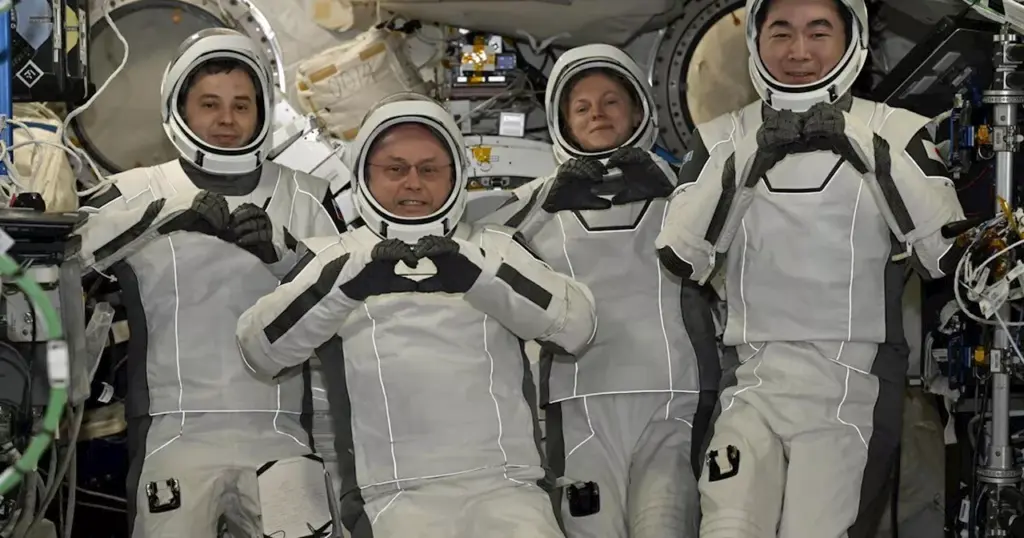
“This was a deliberate decision to allow the right medical evaluations to happen on the ground, where the full range of diagnostic capability exists,” Fincke noted. He also shared a photo of Crew 11 preparing their pressure suits, highlighting the calm and methodical approach taken in the lead-up to their return.
The early return marks a historic moment for NASA, being the first time a crew mission has been cut short due to a medical issue. James Polk, NASA’s chief medical officer, confirmed on Friday that, based on statistical analyses, a medical evacuation should occur approximately every three years. Remarkably, there have been none until now. “Even in this case, we’re erring on the side of caution,” Polk stated, reinforcing the agency’s commitment to crew safety.
Fincke plans to officially hand over command of the ISS to cosmonaut Sergey Kud-Sverchkov during a ceremony on Monday afternoon. He praised the efforts of NASA personnel, stating, “What stands out most to me is how clearly NASA cares about its people.”
With the departure of Crew 11, Kud-Sverchkov and his Soyuz MS-28 crewmates, including Sergey Mikaev and NASA astronaut Chris Williams, will manage the station until Crew 11’s replacements arrive. Currently, Crew 12, consisting of Jessica Meir, Jack Hathaway, Sophie Adenot of the European Space Agency, and Andrey Fedyaev, is scheduled for launch on February 15, 2024. NASA is exploring the possibility of advancing this timeline.
“With the ISS in great hands,” Fincke remarked, “the three crewmates who arrived in November will continue the mission, and they will be joined by Crew 12 in just a few weeks.” As they prepare for their return, the astronauts look forward to reuniting with loved ones and receiving the best possible medical care.