Automation tools are designed to streamline tasks and reduce manual oversight. However, they often come with challenges, particularly when failures occur without notification. This is where Healthchecks.io steps in, offering a solution that alerts users when their automation jobs do not run as expected.
Automation can simplify processes such as backups, file synchronization, and scheduled tasks. Yet, when these systems fail—be it a cron job that does not execute or a script that exits with an error—users frequently remain unaware until it is too late. The absence of immediate feedback can lead to significant issues, particularly for those managing multiple automation jobs across varied systems, including Raspberry Pis and network-attached storage (NAS).
Addressing Silent Failures
Silent failures pose a significant problem for automation users. A cron job that fails to run leaves no trace, making it difficult to identify issues quickly. The simplicity of cron jobs is both an advantage and a disadvantage; they are easy to set up but do not provide the necessary alerts when something goes awry. Healthchecks.io offers a straightforward yet effective solution by allowing jobs to check in with the service. If the expected check-in does not occur, a notification is sent to the user, minimizing the chances of being caught off guard.
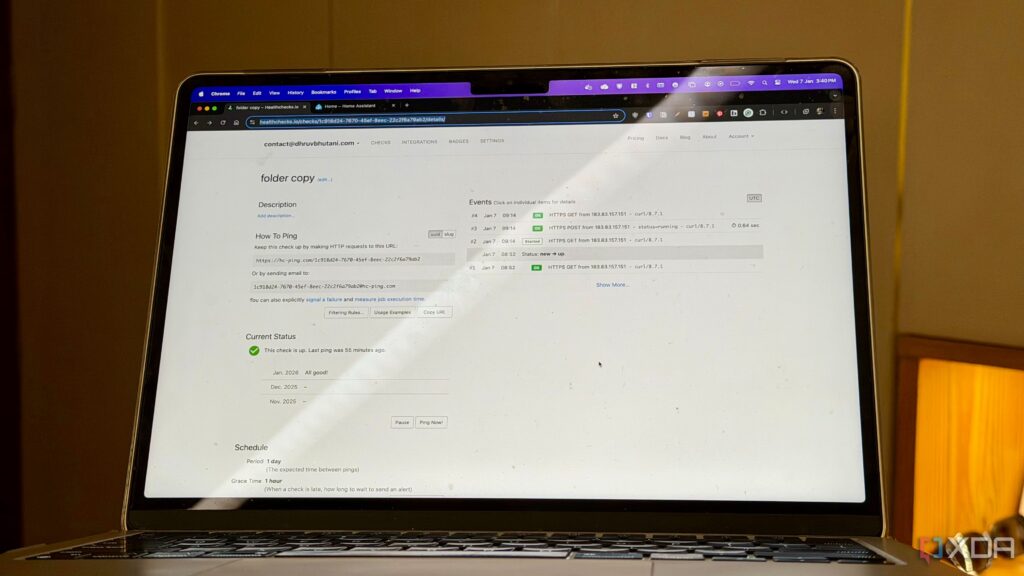
Setting up Healthchecks.io is a quick process. Users can create an account and receive a unique ping URL in just a few minutes. By adding a simple line to their scripts or cron jobs, users can ensure that the service tracks their job status efficiently. If a job runs successfully, it pings the URL, confirming completion. Conversely, if the ping does not arrive on time, the system alerts the user via email.
Simplifying Monitoring for Users
The setup process is designed to be passive, which is a key advantage for many users. While logs can be accessed for further detail, the primary function of Healthchecks.io is to provide alerts without requiring constant monitoring. Users can focus on their tasks, confident that they will receive notifications if a job fails.
For more complex tasks, users can implement additional pings to indicate the start, completion, and any failures that occur during execution. This feature provides a clearer picture of job performance, allowing users to address issues more effectively. The service is particularly advantageous for those who prefer email notifications, as it enables users to filter and organize alerts conveniently.
Healthchecks.io supports various integrations, including chat platforms, although many users find the email notification system sufficient for their needs. The service’s straightforward design focuses on its core functionality—monitoring automation jobs—without unnecessary features or complexity.
Using Healthchecks.io has proven beneficial for users managing multiple automation tasks. Its simplicity makes implementation quick and easy, eliminating the mental uncertainty often associated with critical backups. Additionally, relying on a third-party service mitigates the risk of local system failures impacting monitoring capabilities. This centralized approach allows users to oversee health checks from various devices and systems without the complications of self-hosted logging.
While more comprehensive monitoring platforms exist, offering in-depth logs and analytics, Healthchecks.io serves a specific need: to confirm whether a task succeeded or failed. For many users, this simplicity is a significant asset, and the service effectively fulfills its purpose. Those interested in further customization can opt for the self-hosting option, though the free, online version is sufficient for most individual users.
In conclusion, Healthchecks.io addresses a critical gap for automation users, providing timely notifications of job failures and enhancing overall operational efficiency. By simplifying the monitoring process, the service enables users to focus on their tasks without the anxiety of potential silent failures.