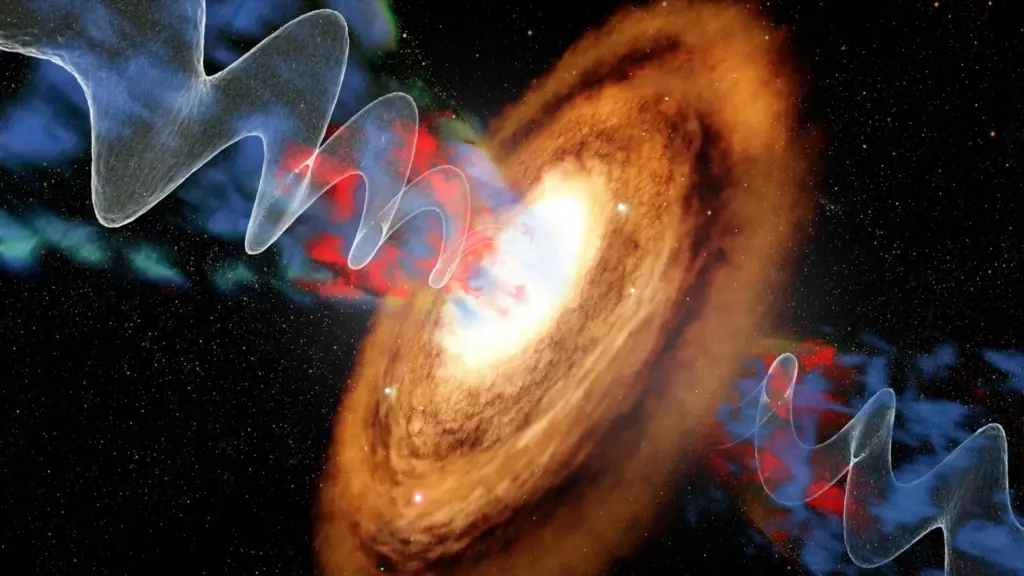
A team of astronomers from the University of California, Irvine, has uncovered a remarkable stream of super-heated gas erupting from the nearby galaxy known as VV 340a. This discovery, facilitated by data from NASA’s James Webb Space Telescope, reveals a massive outflow driven by a supermassive black hole at the galaxy’s center, producing energy equivalent to 10 quintillion hydrogen bombs detonating every second.
The findings, published on March 15, 2026, in the journal *Science*, showcase jets of gas stretching beyond the galaxy itself. These jets form two extensive nebulae that are shaped by the intense activity surrounding the black hole. Each nebula extends at least three kiloparsecs in length, equivalent to approximately 19 trillion miles. For context, the entire disk of VV 340a measures only about three kiloparsecs in thickness.
Justin Kader, the lead author of the study and a postdoctoral researcher in physics and astronomy at UC Irvine, noted, “In other galaxies, this type of highly energized gas is almost always confined to several tens of parsecs from a galaxy’s black hole. Our discovery exceeds what is typically seen by a factor of 30 or more.”
Revealing the Jets and Their Impact
The discovery of the jets was made possible through radio observations conducted at the Karl G. Jansky Very Large Array near San Agustin, New Mexico. These jets form when gas spiraling into a supermassive black hole reaches extreme temperatures, causing it to interact with powerful magnetic fields. The energized material is then launched outward at incredible speeds, creating a spiral-like pattern in space due to a phenomenon known as “jet precession.”
Kader remarked, “This is the first observation of a precessing kiloparsec-scale radio jet in a disk galaxy. To our knowledge, this is the first time we have seen a kiloparsec, or galactic-scale, precessing radio jet driving a massive coronal gas outflow.”
The jets force surrounding material away from the galaxy’s center, heating it to extreme temperatures and forming what scientists refer to as coronal line gas. This highly ionized plasma is typically found near black holes and is rarely observed extending far into the host galaxy.
Insights from Multiple Observatories
The full extent of this phenomenon only became clear when the researchers combined data from various telescopes. Observations from the Keck II Telescope in Hawaii revealed cooler gas extending up to 15 kiloparsecs from the black hole. The scientists believe this cooler material serves as a “fossil record” of earlier jet activity, comprised of remnants leftover from previous expulsions of gas from the galaxy’s core.
The James Webb Space Telescope played a crucial role in this discovery. Positioned about one million miles from Earth, it is the largest space telescope ever constructed and specializes in observing the universe in infrared light. This capability allowed it to penetrate the dust surrounding VV 340a, which obscures visible light and hinders other telescopes from viewing the galaxy’s interior.
The effects of the black hole jets on VV 340a are profound. The study indicates that the galaxy is losing enough gas each year to form 19 stars similar to our sun. Kader explained, “What it really is doing is significantly limiting the process of star formation in the galaxy by heating and removing star-forming gas.”
With no similar jets currently active in the Milky Way, the findings from VV 340a provide insights into the historical activity of black holes. Kader pointed out that evidence suggests our supermassive black hole underwent a feeding event approximately two million years ago, which might have been observable to early human ancestors.
The researchers now intend to explore other galaxies for similar features to enhance their understanding of how powerful black hole activity can shape the evolution of galaxies. “We are excited to continue exploring such never-before-seen phenomena at different physical scales of galaxies using observations from these state-of-the-art tools, and we can’t wait to see what else we will find,” said Vivian U, a former UC Irvine research astronomer now at Caltech’s Infrared Processing and Analysis Center.
Funding for this research was provided by NASA and the National Science Foundation, highlighting the collaborative effort behind this groundbreaking discovery.