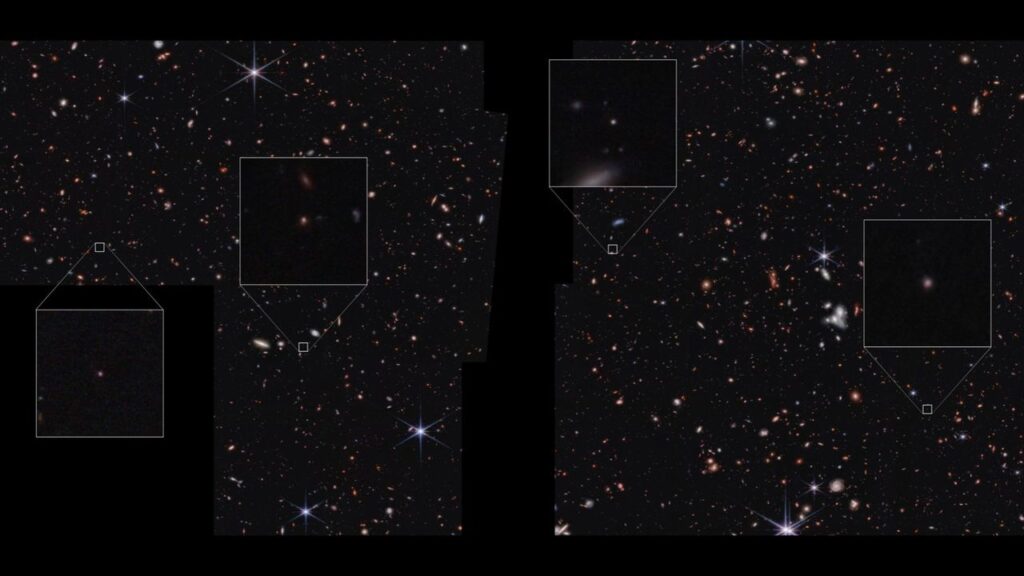
Unusual cosmic objects observed by NASA’s James Webb Space Telescope (JWST) have sparked significant interest among astronomers, who are considering the possibility that these findings represent a new class of celestial bodies, dubbed “platypus” galaxies. This name reflects the animals’ unique combination of features, much like the peculiar characteristics exhibited by the objects detected in the early universe.
At a news conference on January 6, 2023, during the annual meeting of the American Astronomical Society in Phoenix, astronomer Haojing Yan from the University of Missouri shared insights into these enigmatic entities. Initial observations suggested they resembled stars, appearing as small points of light in JWST data. However, further analysis revealed more galaxy-like attributes, leading researchers to reevaluate their classifications.
The investigation began shortly after the JWST was operational in 2021, when it unveiled a variety of unusual objects of unknown origin. Yan and his students scrutinized approximately 2,000 compact sources to identify any anomalies that may have been overlooked. Ultimately, they focused on nine distinct objects that were slightly larger than typical point sources and exhibited characteristics suggestive of either galaxies or an unknown category.
“These objects are very close to being point sources, but not exactly,” Yan explained. The researchers discovered that, unlike broad emission lines typically associated with stars, these objects emitted narrow lines indicative of active star formation commonly found in galaxies.
While the newfound objects share similarities with known classifications of quasars—quasi-stellar objects powered by supermassive black holes in the centers of galaxies—they do not fit neatly into this category. For instance, they are dimmer than expected, and their spectral fingerprints are narrower than those of narrow-line quasars. “Our objects are not quasars,” Yan clarified.
The findings raise intriguing possibilities about the nature of these objects. They could potentially belong to a new category of active galactic nuclei (AGN), specifically known as narrow-line AGNs. However, known narrow-line AGNs typically appear as point sources, complicating their classification. Yan noted, “If our objects end up within the narrow-line AGN classification, they must be of a new kind.”
Another hypothesis suggests that these peculiar objects may be young star-forming galaxies. Star-forming galaxies are known for their accelerated star production, and they also emit narrow emission lines. Bangzheng Sun, also from the University of Missouri, emphasized that if these objects are indeed star-forming galaxies, they are likely to be very young—no more than 200 million years old. “They are still in their infancy,” he stated.
The slightly expanded size of these objects presents additional questions. Sun remarked that if the objects are galaxies, they appear to be forming stars from the inside out, a process that has not been observed before. “This is a process we have not seen before,” he said, highlighting the novelty of their findings.
Yan indicated that the inside-out process could be occurring in multiple galaxies. He suggested that while star formation typically induces chaotic motion, the processes observed in these new objects might be happening in a more subdued manner, allowing their point-like appearance to remain intact.
As researchers continue to analyze these findings, the question of whether these objects represent a new form of AGN or unusual young galaxies remains open. Yan expressed optimism about future observations with the JWST, stating, “These nine objects are special. They are our platypuses.” The scientific community eagerly anticipates further investigations to uncover the mysteries surrounding these extraordinary cosmic entities.