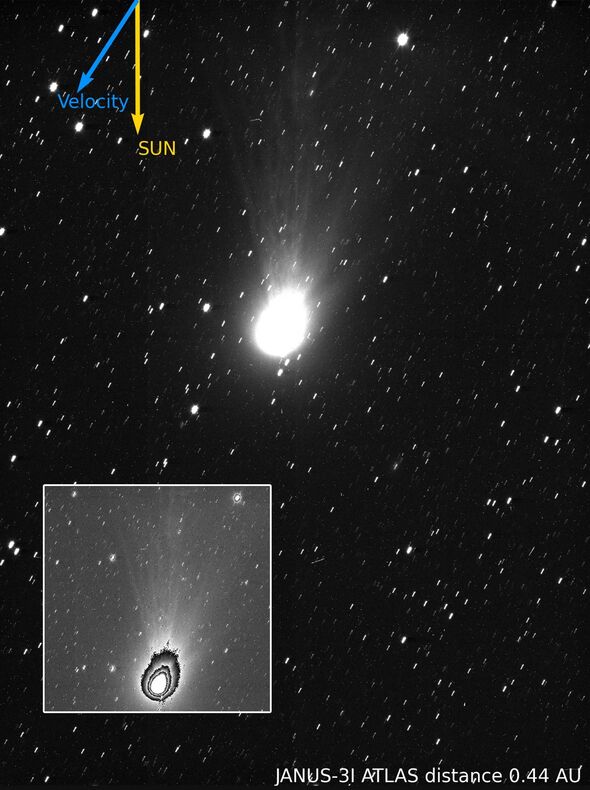
In a remarkable discovery, astronomers have unveiled unusual features of the interstellar object known as 3I/ATLAS, including three symmetrical jets emerging from its core. This celestial body, which was first identified in July 2025, has sparked significant debate about its origins and what these jets may represent, with some suggesting a technological underpinning rather than a purely natural phenomenon.
Recent images captured by the Hubble Space Telescope have revealed these jets, which appear to extend at regular intervals of 120 degrees, creating a striking geometric pattern. This configuration challenges traditional explanations of cometary activity, as the jets do not align with the sun’s expected influence, leading to speculation about possible internal mechanisms. According to Avi Loeb, a prominent astronomer from Harvard University, this unique symmetry could indicate a “technological signature,” prompting discussions about advanced extraterrestrial civilizations.
Examining the Jets and Their Behavior
The jets of 3I/ATLAS were documented in a sequence of 17 images between November 30 and December 27, 2025. The observation of slight wobbling in the jets adds complexity to the analysis, particularly with the presence of an “anti-tail” that points toward the sun. This unusual feature is typically associated with perspective effects during a comet’s orbit, but its rhythmic behavior remains a mystery, as noted in a December 23, 2025, article by Space.com.
Public interest has surged on social media platforms, especially on X (formerly Twitter), where experts and enthusiasts have shared their interpretations of the jets. Posts describing the jets as “razor straight” and “stable” have fueled discussions about whether 3I/ATLAS represents a new class of celestial objects.
While some scientists advocate for caution in interpreting these findings, an international team of researchers asserted in a January 3, 2026, article on Yahoo News that despite its peculiarities, 3I/ATLAS aligns with the characteristics of typical comets. They highlight its unelongated nucleus and coma as evidence against the idea of artificial origins.
Conversations Around Origins: Natural vs. Artificial
Loeb’s theories have reignited debates on the nature of celestial objects. He questions whether the symmetrical jets could suggest a deliberate structural design by an advanced civilization. While traditional comet behavior typically results in irregular bursts from ice sublimation, the consistent pattern observed in 3I/ATLAS raises intriguing possibilities.
Counterarguments point out that earlier interstellar visitors like ‘Oumuamua exhibited different behaviors, having shown anomalous acceleration without any visible outgassing. In comparison, 3I/ATLAS presents a coma and tail similar to solar system comets, yet its interstellar speed and origin set it apart from its predecessors.
Recent analyses, including a study referenced in a January 2, 2026, article from DNyuz, suggest that 3I/ATLAS exhibits more typical comet-like properties. The findings, which include a profile rich in carbon dioxide and nickel, challenge claims of artificial design while reinforcing the notion of natural formation.
Additionally, an international team utilized the world’s largest single-dish radio telescope to scan for any potential technosignatures during 3I/ATLAS‘ closest approach to Earth. Results released on January 3, 2026, by Futurism indicated no artificial emissions, further supporting the theory of its natural origins.
Despite a lack of evidence for artificiality, the absence of signals leaves room for speculation about dormant technologies, a point Loeb continues to emphasize in his commentary.
Historical Context and the Future of Interstellar Studies
The discovery of 3I/ATLAS adds to the brief but fascinating history of interstellar objects, following ‘Oumuamua in 2017 and 2I/Borisov in 2019. Each of these encounters has generated similar discussions, but the active features of 3I/ATLAS offer more data for analysis. Observations have revealed coherent jets that defy easy explanation and necessitate a reevaluation of existing comet physics.
Loeb’s ongoing investigations into these phenomena are crucial. His analyses of the Hubble images and proposed models for both natural and artificial origins highlight the growing intersection of astronomy and the search for extraterrestrial intelligence.
As interest in 3I/ATLAS continues to grow, the scientific community remains divided. Social media discussions reflect a public fascination with the potential for alien technology, further fueled by media coverage that amplifies these debates.
Looking forward, the implications of these jets extend to our understanding of propulsion in space. If the jets are indeed natural, they could reshape our models of interstellar comet formation, potentially involving unique ices or internal heat sources. If artificial, they could inspire new technologies and approaches in space exploration.
Ongoing research will include spectral analysis of the jets’ composition, which will be vital in determining their origins. As 3I/ATLAS moves further away, the opportunity for detailed study diminishes, underscoring the importance of the data collected by the Hubble Space Telescope.
The excitement surrounding 3I/ATLAS highlights the need for enhanced telescopic capabilities. Proposals for dedicated interstellar object observatories are gaining traction, potentially transforming our ability to study these extraordinary visitors.
Ultimately, the investigation of 3I/ATLAS represents a significant moment in the ongoing quest to understand the universe. Whether the symmetrical jets are the result of alien ingenuity or cosmic coincidence, they challenge our preconceptions and drive the advancement of scientific inquiry.