The United States has captured Venezuelan President Nicolás Maduro in a significant overnight military operation, as confirmed by President Donald Trump on Saturday. This marks a decisive intervention in Latin America, the first of its kind since the invasion of Panama in 1989. Trump announced the operation at a press conference held at his Mar-a-Lago resort in Florida, where he highlighted the effectiveness of American military capabilities.
Trump stated, “We’re going to run the country until such time as we can do a safe, proper and judicious transition.” He emphasized the importance of ensuring that any successor to Maduro prioritizes the interests of the Venezuelan people. The President was accompanied by senior officials, including Secretary of Defense Pete Hegseth and Secretary of State Marco Rubio.
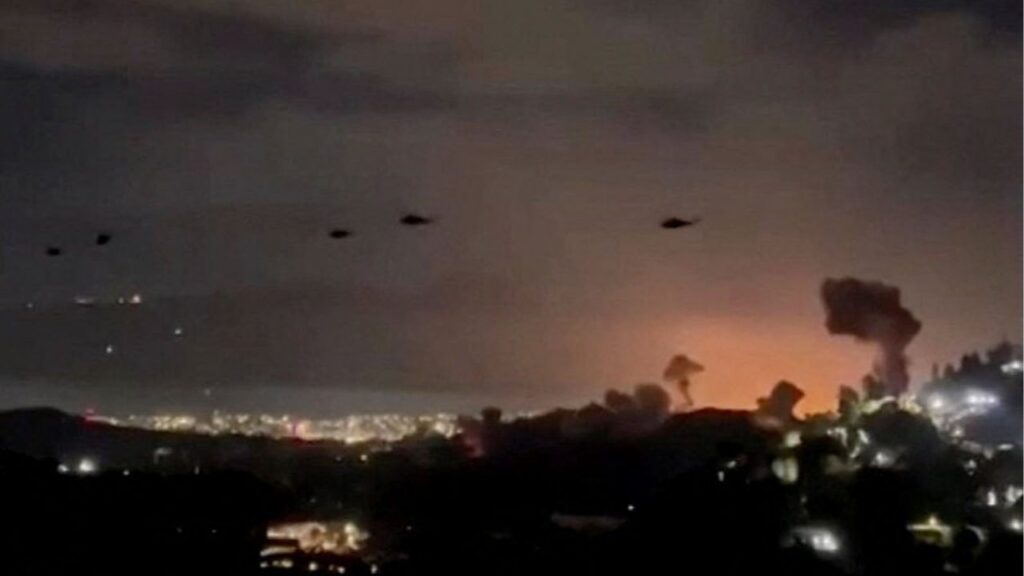
Despite the operation’s success in capturing Maduro, who had been a controversial leader for over 12 years, uncertainty looms over Venezuela’s immediate future. While Maduro is in custody, the extent of U.S. control over the country remains unclear. Reports suggest that electricity was disrupted in parts of Caracas during the operation, but Maduro’s administration appears to still be functioning.
Potential Consequences of Maduro’s Removal
The removal of Maduro, who has been accused of running a “narco-state” and manipulating the 2024 election, raises concerns about a potential power vacuum. Delcy Rodriguez, the Venezuelan Vice President and presumed successor, is reportedly in Russia, leading to confusion about the leadership transition. The Russian government has denied the claim regarding Rodriguez’s location, calling it “fake.”
Any destabilization in Venezuela, a nation of approximately 28 million people, could present a significant challenge for the U.S., reminiscent of the complexities faced during interventions in Afghanistan and Iraq. The United States has not engaged in such direct action in its neighboring region since the 1989 Panama invasion aimed at ousting military leader Manuel Noriega.
Reactions from Venezuelan Officials and International Community
As dawn broke in Venezuela, the streets remained relatively calm, with military presence noted in some areas. Pro-Maduro gatherings began to form in Caracas, while others expressed relief over the news. “I’m happy, I doubted for a moment that it was happening because it’s like a movie,” stated Carolina Pimentel, a merchant from Maracay.
Venezuelan officials condemned the U.S. operation. Defense Minister Vladimir Padrino emphasized the strength found in the unity of the people to resist foreign intervention. While some Latin American governments oppose Maduro, the direct U.S. action evokes painful memories of past interventions, which are generally met with skepticism by regional leaders and populations.
Trump’s actions echo historical U.S. policies such as the Monroe Doctrine, established in 1823, which asserted American influence in the region. It also recalls the “gunboat diplomacy” of President Theodore Roosevelt in the early 20th century.
Venezuela’s allies, including Russia, Cuba, and Iran, swiftly condemned the U.S. intervention. Tehran has called on the U.N. Security Council to address what it describes as “unlawful aggression.”
In contrast, reactions among major Latin American nations vary, with Argentine President Javier Milei praising Venezuela’s new “freedom,” while Mexican officials have voiced strong opposition to the intervention. Brazilian President Luiz Inacio Lula da Silva described the U.S. actions as crossing “an unacceptable line.”
As the situation develops, the international community watches closely, aware that the implications of this intervention could reshape the political landscape in Venezuela and beyond.