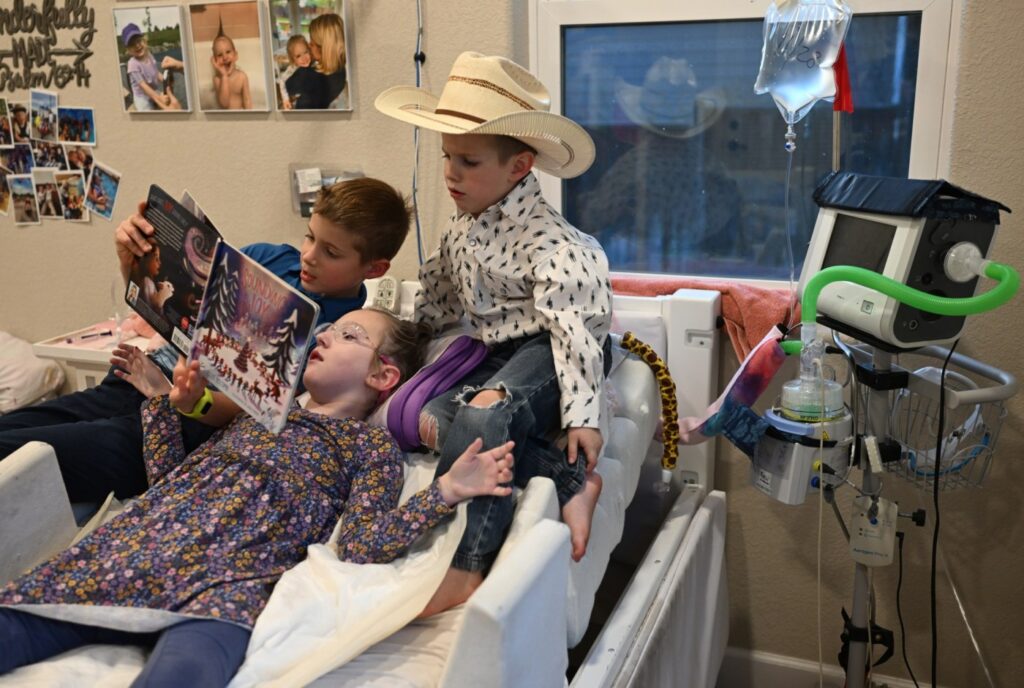
A family from Fort Collins, Colorado, is on a mission to raise $4 million to fund gene therapy trials for their daughter, Everly Green, who suffers from a rare genetic disorder. At just 8 years old, Everly is unable to move her body, communicating solely through her eyes via a screen. The Greens are part of a small community advocating for research into the FRRS1L gene mutation, a condition affecting only a few dozen children worldwide.
Initially, Everly’s parents were puzzled by their doctors’ recommendations for genetic testing. Despite her delays in reaching developmental milestones, Everly showed signs of progress until she experienced seizures at the age of 2. This sudden decline in her abilities led to the need for a feeding tube. Everly’s mother, Chrissy Green, emphasized her daughter’s cognitive awareness, stating, “These kids are in there, they want to play like other kids; they just can’t move.”
The foundation that Chrissy co-leads, Finding Hope for FRRS1L, is dedicated to raising funds for gene therapy development. It aims to assist children like Everly, who are cognitively aware but physically limited. According to the foundation’s website, children with the FRRS1L gene disorder “are trapped in a body they can’t move, however still retain high cognitive function, understanding, communication and awareness.”
With limited pharmaceutical industry interest in such rare conditions, families have taken it upon themselves to fund research and treatment development. If successful in securing the necessary funding, the Greens hope to work with the U.S. Food and Drug Administration (FDA) to ensure the treatment is deemed safe and effective for market release. However, even if they achieve FDA approval, they may face challenges with insurance companies reluctant to cover the high costs of gene therapies.
The gene therapy process involves replacing a faulty gene with a healthy one, often using a harmless virus to deliver the new genetic material. This innovative treatment has shown promise in restoring function for various conditions, including severe immune deficiencies and certain inherited diseases. Yet, the technology carries inherent risks; some patients have experienced severe side effects, including liver complications.
Most pharmaceutical companies typically assume the financial burden associated with transforming research into market-ready treatments, yet this model is strained for rare conditions like Everly’s. Neil Hackett, a researcher familiar with gene therapy, noted, “A drug that treats so few patients will never be profitable, so parents are largely on their own in trying to fund research and development.”
When the Greens first learned of Everly’s diagnosis, they were advised to cherish their time together, as existing medical solutions were limited. Initially focused on adjusting to their new reality, Chrissy connected with other families online, sharing experiences and seeking support. One connection led her to Viviana Rodriguez in London, who was also exploring potential treatments for her child with the same condition.
A series of fortunate events brought Chrissy and Rodriguez together with a researcher at the University of Texas Southwestern Medical Center. This collaboration has enabled them to fund research on FRRS1L by raising $400,000 to study gene therapy in mice with the mutation. Early results from these studies have been promising, with treated mice displaying near-normal movement.
As they pursue funding for the next stages of development, Green expressed her optimism. “We saw major recovery in the animals, so we’re really hopeful for our kids,” she stated. The next phase involves testing for potential side effects and locating a manufacturer capable of producing the therapy.
While the pathway to human trials is filled with uncertainties, Green remains hopeful that their efforts will benefit not only Everly but also future patients diagnosed with the same mutation. “All the diseases can kind of help each other move forward,” she said.
Navigating the FDA approval process and securing insurance coverage for such specialized treatments poses additional challenges. Hackett acknowledged that while the foundation could potentially reserve treatments for future diagnoses, the reality is that commercial partnerships may ultimately be necessary.
As Everly continues to inspire her family and supporters, the Greens remain committed to their mission. They aim to change the lives of children like Everly, who, despite their physical limitations, possess the same desires and dreams as any other child.