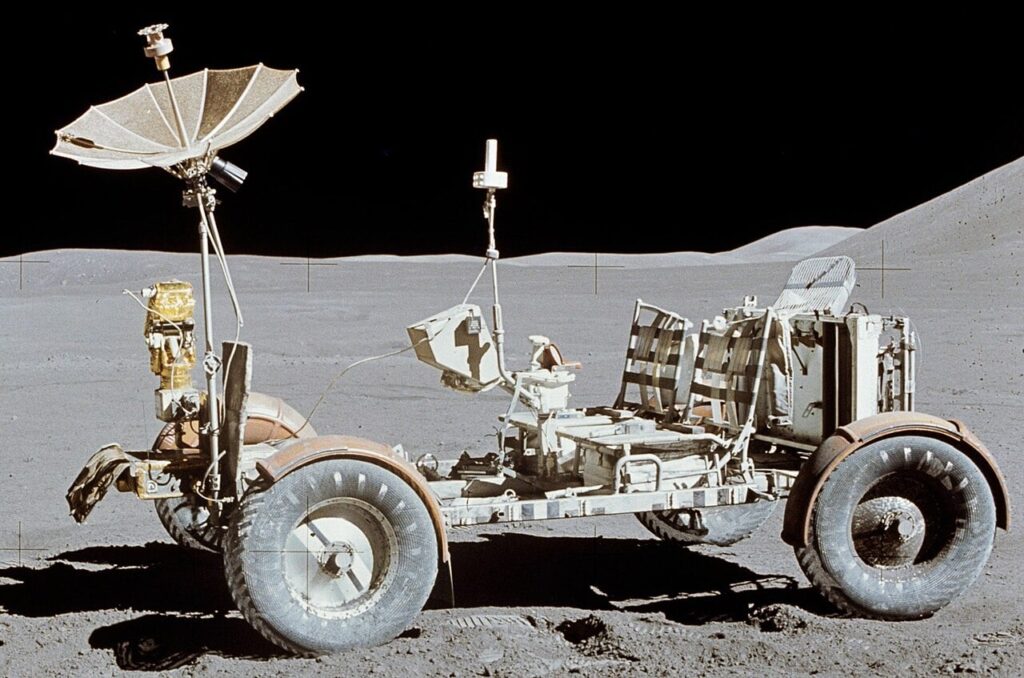
Recent advancements in lunar exploration technology have resulted in the development of a groundbreaking wheel designed for navigating the Moon’s rugged terrain. Researchers from the Korea Advanced Institute of Science and Technology (KAIST) have introduced an innovative origami-inspired wheel that could facilitate access to the Moon’s underground lava tubes and pits, which are believed to be crucial for future lunar bases.
Located beneath the Moon’s cratered surface, these natural caves offer protection from cosmic radiation and extreme temperature variations. However, the challenges of accessing these areas are significant, as the entrances are often characterized by steep and rugged terrain. Traditional small rovers, commonly deployed for lunar missions, are limited by their compact wheels, which struggle to overcome obstacles larger than their diameter. Consequently, a failure of a single large rover can jeopardize an entire mission, while multiple smaller rovers provide redundancy.
The newly developed variable diameter wheel addresses these challenges by expanding when necessary to navigate obstacles, then contracting for efficient transport. This concept has been difficult to realize due to the Moon’s harsh environment, which is hostile to mechanical systems. Fine lunar dust infiltrates machinery, and the absence of an atmosphere causes exposed metal surfaces to bond through cold welding, leading to the failure of traditional joints and hinges.
Professor Dae-Young Lee led the research team that found a solution by drawing inspiration from the past. They combined principles from Leonardo da Vinci‘s self-supporting bridge designs with origami folding techniques to create a wheel that transforms without the need for conventional mechanical joints. The innovative design utilizes an elastic metal frame and fabric tensioners that flex, allowing the wheel to expand from a compact 230 millimetres to 500 millimetres in diameter.
This adaptability enables a small rover, equipped with the new wheels, to maintain a low profile during transport while gaining the capability to climb like a significantly larger vehicle on the lunar surface. The team conducted extensive testing with artificial lunar soil, demonstrating that the wheel exhibited superior traction on loose slopes. Remarkably, it withstood a drop impact equivalent to falling 100 metres in lunar gravity.
Significance of Lunar Exploration Technology
Dr. Chae Kyung Sim from the Korea Astronomy and Space Science Institute highlighted the scientific importance of this work. He referred to lunar pits as “natural geological heritages,” emphasizing that this technology could facilitate exploration of these valuable sites. Furthermore, Dr. Jongtae Jang from the Korea Aerospace Research Institute noted that the wheel was designed using thermal models to withstand temperature fluctuations that can reach 300 degrees Celsius between lunar day and night.
Despite the technological advancements, Professor Lee acknowledged that challenges remain, particularly regarding communication and power systems. Nevertheless, he expressed optimism that their unique design positions the research team as potential leaders in future lunar exploration missions targeting the Moon’s enigmatic underground environments.
The development of the origami wheel represents a significant step forward in the quest to explore the Moon’s hidden geological features. As research continues, this innovative technology may pave the way for sustainable lunar bases and further scientific discoveries on Earth’s celestial neighbor.