Republican leaders are increasingly uniting behind Vice President JD Vance as discussions about the 2028 presidential race intensify. Following the assassination of Charlie Kirk, founder of Turning Point USA, the organization is mobilizing to support Vance’s potential candidacy. With plans to deploy representatives across all 99 counties in Iowa in the coming months, Turning Point USA aims to establish a robust campaign infrastructure that could secure a significant victory for Vance.
Insiders indicate this initiative is part of a broader strategy among some within Donald Trump’s circle to eliminate competition in the Republican primary. Earlier this month, Marco Rubio, previously mentioned as a potential contender, signaled his withdrawal from the race, stating, “If Vance runs for president, he’s going to be our nominee, and I’ll be one of the first people to support him,” during an interview with Vanity Fair.
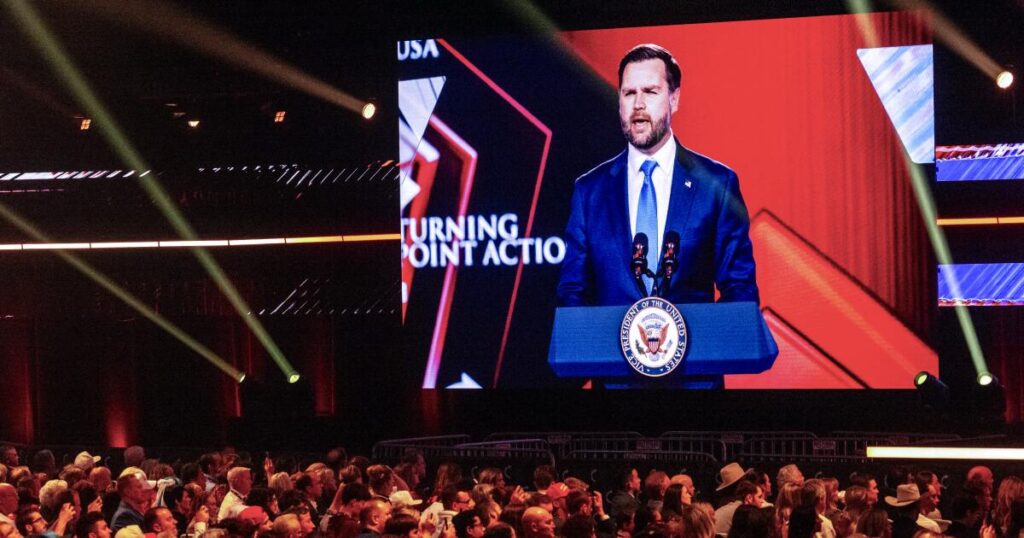
The enthusiasm surrounding Vance was evident at Turning Point USA’s annual conference in Arizona, where Erika Kirk, Charlie Kirk’s widow, endorsed him. A straw poll conducted at the event revealed that 84% of attendees would support Vance in the upcoming primaries. Nevertheless, broader public sentiment appears more fragmented. A CNN poll conducted in early December showed Vance garnering 22% of Republican support for 2028, while other notable figures like Rubio and Florida Governor Ron DeSantis received single-digit support. Remarkably, 64% of respondents indicated they had “no one specific in mind,” suggesting an open field for other candidates.
While a recent Gallup poll indicated that 91% of Republicans approve of Vance’s performance as vice president, only 39% of Americans across party lines view him positively. This disparity could pose challenges for Vance if he secures the nomination.
As political figures across the spectrum evaluate their prospects in the lead-up to the primaries, Vance emphasized the need for party unity at the close of the Turning Point USA conference. He addressed rising tensions within Republican circles regarding racism and antisemitism, stating, “President Trump did not build the greatest coalition in politics by running his supporters through endless, self-defeating purity tests.” Vance’s remarks underscored his commitment to inclusivity, asserting that “every American is invited,” regardless of background.
Despite this call for unity, Vance’s approach has faced backlash from some right-wing commentators who accuse him of tolerating bigotry. Notably, he has been subjected to racist attacks, particularly from Nick Fuentes, a far-right podcaster. In a recent interview, Vance fiercely defended his family against such rhetoric, stating, “Let me be clear — anyone who attacks my wife, whether their name is Jen Psaki or Nick Fuentes, can eat s—.”
While Trump has publicly acknowledged Vance’s capabilities, he has not formally endorsed his nomination. He referred to Vance as “very capable” and the “most likely” choice for the party. Nevertheless, discussions surrounding Trump’s potential third term have surfaced, despite constitutional limitations outlined in the 22nd Amendment. Trump himself has indicated an understanding of these constraints.
Steve Bannon, a key architect of Trump’s 2016 campaign, has expressed skepticism about Vance’s toughness to lead the party, suggesting that the vice president may not be the right fit for the presidency. In a profile by Vanity Fair, White House chief of staff Susie Wiles confirmed, “He knows he can’t run again.” Meanwhile, Alan Dershowitz, a prominent constitutional law scholar, recently presented Trump with potential pathways for a third term, although he concluded that Trump would likely refrain from pursuing another candidacy.
As the political landscape evolves, Vance’s position within the Republican Party remains pivotal. With the primary season approaching, the dynamics among potential candidates will continue to shift, influencing the future direction of the GOP.