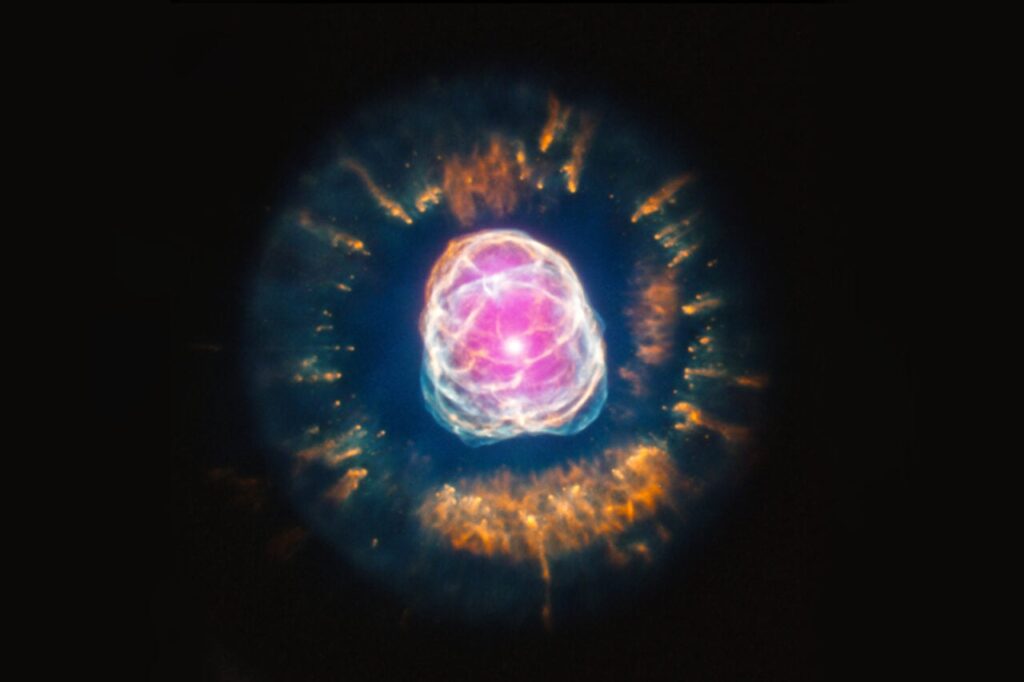
Astrophysicists from the University of British Columbia have proposed a new avenue for exploring dark matter through the study of white dwarfs, the dense remnants of dead stars. Their analysis, which appears on the preprint server arXiv but has yet to undergo peer review, offers a theoretical framework connecting axions—hypothetical particles believed to be a leading candidate for dark matter—to the cooling behavior of these stellar remnants.
The concept of axions originated in 1977 as a potential solution to the imbalance between matter and antimatter in the quantum realm. Initially, the idea gained traction, but it faded over time as detection efforts failed. Axions are theorized to be weakly interacting with other matter and possess low mass, aligning with current understandings of dark matter, which constitutes approximately 85% of the universe’s total mass.
Dark matter is notoriously elusive, interacting rarely with observable matter. This has made it challenging for scientists to identify its presence, despite ample indirect evidence suggesting its existence. The researchers turned their attention to white dwarfs, which are typically cold and inactive stellar cores that remain after a star’s life cycle.
Understanding White Dwarfs and Axions
White dwarfs are dense enough that they should collapse under their own gravitational pressure. However, they resist this collapse due to a phenomenon known as electron degeneracy pressure. In simple terms, electrons cannot occupy the same energy state, leading to increased speeds that generate sufficient pressure to maintain the star’s structure.
The study highlights the intriguing possibility that axions could form from the rapid movement of electrons within these stars. Previously, observations indicated that some white dwarfs cool off faster than expected. The researchers hypothesized that if axions were being produced, they could explain this unexpected energy loss, as escaping axions would draw energy from the star.
To investigate their hypothesis, the team analyzed archival data from the Hubble Space Telescope and conducted simulations to understand the potential impact of axions on white dwarf activity. They formulated predictions about the temperature and age of these stars, comparing their models with actual observations from 47 Tucanae, a globular cluster containing numerous white dwarfs.
Despite thorough simulations, the researchers were unable to find evidence supporting the presence of axion-induced cooling in their models. Their findings indicated that the likelihood of electrons producing axions is roughly one in a trillion.
Implications for Future Research
While the results may appear disappointing, they do not entirely dismiss the possibility of axions. According to Paul Sutter, an astrophysicist at Johns Hopkins University who was not involved in the study, the findings suggest that electrons and axions likely do not interact directly. This insight can guide future research efforts as scientists continue to seek innovative methods for detecting axions and exploring the nature of dark matter.
Sutter emphasized the importance of understanding what does not work in the search for dark matter, stating, “This result doesn’t rule out axions entirely, but it does say it’s unlikely that electrons and axions directly interact with each other.” As the quest for understanding dark matter progresses, researchers may need to adopt even more creative approaches to uncover this elusive component of the universe.