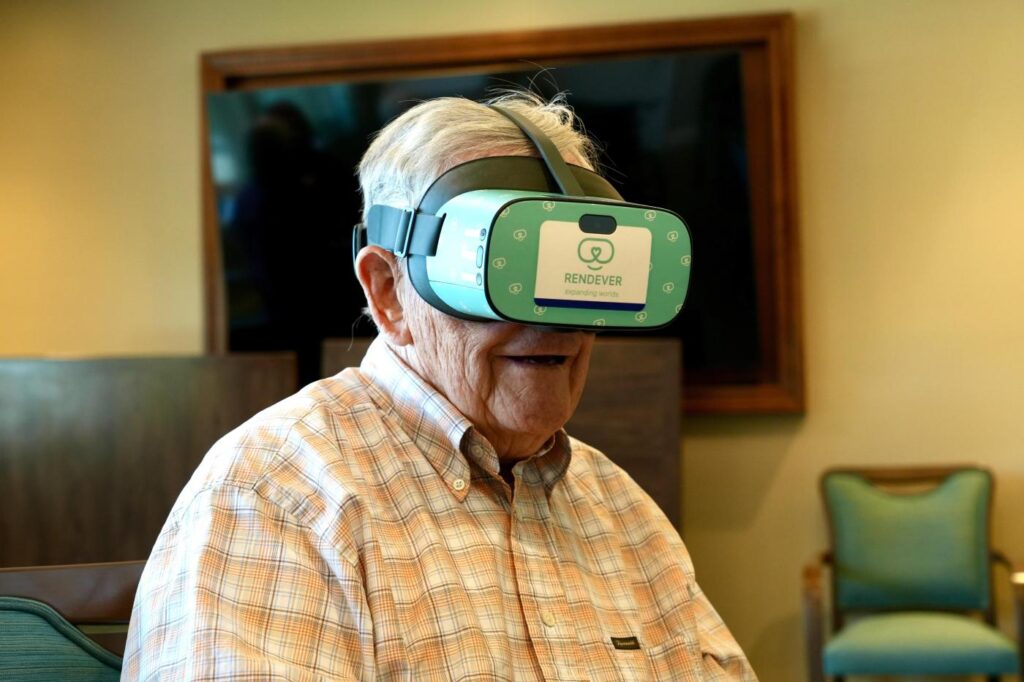
Residents of The Terraces, a retirement community in Los Gatos, California, are experiencing a technological revolution that enhances social interactions through virtual reality (VR). This innovative approach allows seniors, many of whom are in their 80s and 90s, to engage in adventures such as swimming with dolphins or soaring in hot-air balloons, all from the comfort of their community.
Transformative Experiences Through Virtual Reality
The VR sessions, organized by caretakers at The Terraces, utilize headsets provided by Rendever, a company dedicated to improving cognitive function and social engagement among older adults. With a curated selection of immersive experiences, residents can travel to destinations around the world without leaving their chairs.
During a recent session, 81-year-old Ginny Baird expressed her delight after virtually swimming with dolphins. “We got to go underwater and didn’t even have to hold our breath!” she exclaimed, highlighting the joy these experiences bring to residents who may feel isolated.
The VR technology is not only about entertainment; it serves as a bridge to reminisce about the past. Sue Livingstone, 84, recalled her childhood neighborhood in Queens, New York, saying, “It isn’t just about being able to see it again, it’s about all the memories that it brings back.” The ability to revisit significant places can entice even the most hesitant residents to participate.
Building Connections and Reducing Isolation
Adrian Marshall, the community life director at The Terraces, noted that word of mouth plays a crucial role in increasing participation. Residents often share their experiences, sparking curiosity among others who may prefer traditional activities like playing dominoes. “It turns into a conversation starter for them. It really does connect people,” he stated.
Rendever is actively working to broaden its impact, having received a grant of nearly $4.5 million from the National Institutes of Health. This funding aims to explore further methods to reduce social isolation among seniors, particularly those living at home. Research suggests that VR may help maintain cognitive functions and foster social connections, providing a supplementary tool for engagement.
Experts like Katherine “Kate” Dupuis, a neuropsychologist, emphasize the importance of moderation. “There is always a risk of too much screen time,” she explained. “But if you use it cautiously, with meaning and purpose, it can be very helpful.”
Researcher Pallabi Bhowmick from the University of Illinois Urbana-Champaign noted that VR headsets might be more accessible for seniors compared to traditional technology, which often involves complex navigation. “The stereotypes that older adults aren’t willing to try new technology need to change,” she said, emphasizing the positive aspects of VR.
Kyle Rand, co-founder of Rendever, was inspired to create the company after observing the challenges his grandmother faced with aging. “What really fascinates me about humans is just how much our brain depends on social connection,” he remarked. “A group of elderly residents who don’t really know each other that well can come together, spend 30 minutes in a VR experience together, and then find themselves sitting down to have lunch together while continuing a conversation about the experience.”
The introduction of VR in senior living communities is not without competition. Companies like Mynd Immersive, based in Dallas, are also offering VR services tailored for seniors. Both Rendever and Mynd aim to leverage VR as a means to foster social connections and potentially slow the progression of dementia.
At another Silicon Valley retirement community, the Forum, residents are utilizing VR to enhance their quality of life. Bob Rogallo, who has dementia, was seen enjoying a virtual hike through Glacier National Park on his 83rd birthday. His wife, Sallie, noted that the experience brought back happy memories from their past visits.
As the technology continues to evolve, the potential for VR to positively impact the lives of older adults appears promising. With each session, residents at The Terraces and similar communities are reminded that adventure and connection can still be part of their lives, proving that technology can indeed foster a sense of community and belonging.