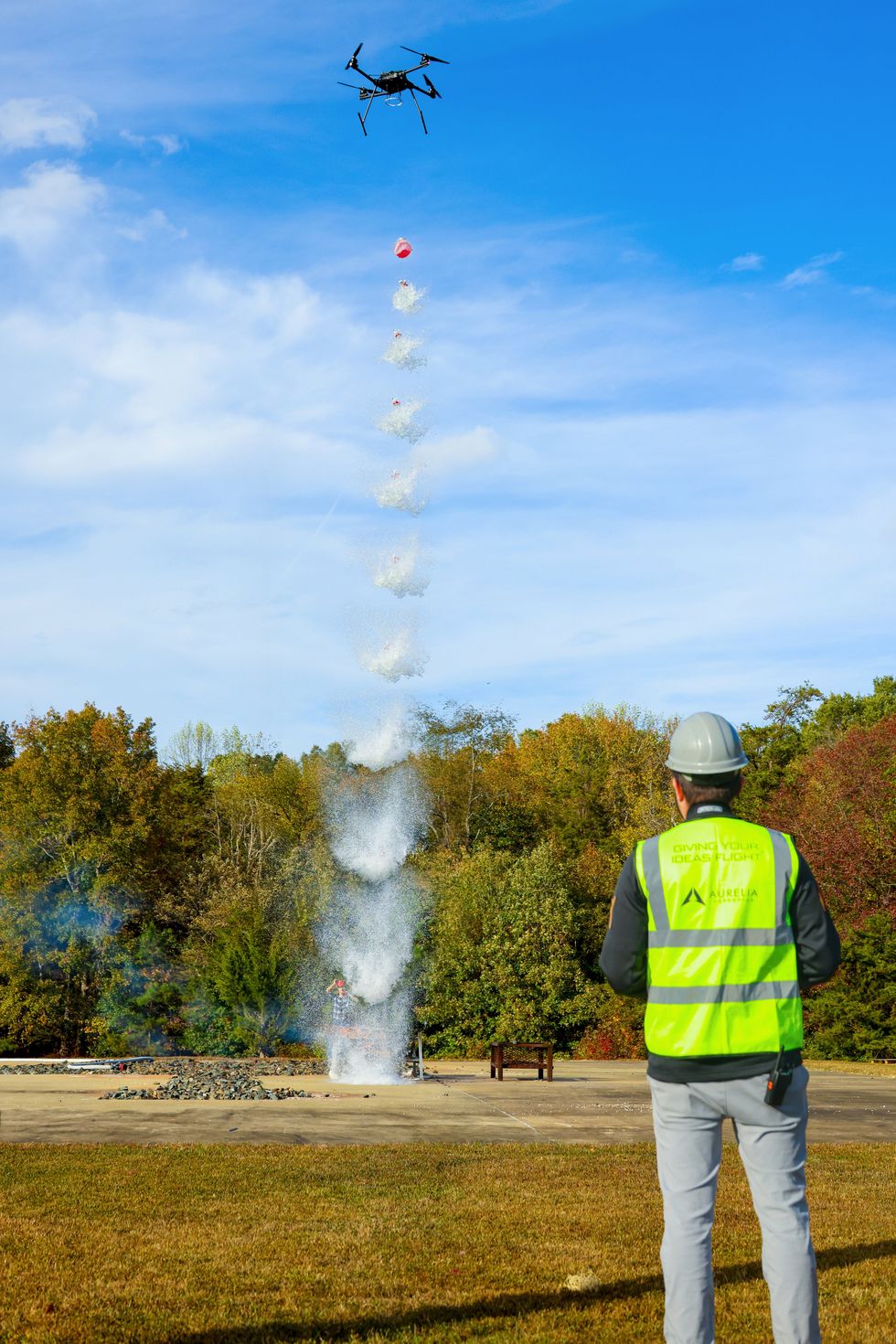
A team from the University of Maryland (UMD) showcased innovative drone technology aimed at improving wildfire detection and suppression during a demonstration in La Plata, Maryland, on October 11, 2023. As part of the XPrize competition, the team, known as Crossfire, is developing systems that utilize drones to identify and extinguish dangerous fires quickly.
The competition challenges participants to find and suppress wildfires within a designated area of 1,000 square kilometers of difficult terrain. The teams must navigate to the fire and extinguish it within a strict time limit of ten minutes. The ultimate prize for the winning team is a substantial $3.5 million reward, which could significantly enhance wildfire-fighting efforts globally.
The demonstration featured the Alta X drone, equipped with a unique payload—a water-filled balloon designed to burst at a specific altitude for optimal dispersal. Operated by doctoral student Andres Felipe Rivas Bolivar, the drone was tasked with dropping the balloon to extinguish a controlled fire. The task proved challenging, requiring precise maneuvering to ensure the balloon detonated effectively above the flames.
At the event, UMD’s team consisted of approximately 20 students and professors, all focused on advancing drone technology for wildfire management. The XPrize Foundation, which organized the competition, aims to accelerate advancements in wildfire detection and suppression technologies, given the increasing severity and frequency of wildfires worldwide.
The Growing Threat of Wildfires
Wildfires have become a major concern, particularly following catastrophic events like the November 2018 Camp Fire in California, which devastated over 620 square kilometers and destroyed much of the town of Paradise. This disaster underscored the urgent need for improved wildfire management strategies and motivated the XPrize Foundation to focus on this critical issue in 2019.
According to Andrea Santy, program director for the wildfire competition, the goal is to significantly reduce response times, which can currently extend to over an hour between fire detection and suppression. The XPrize initiative includes a $1 million reward for teams that can demonstrate rapid and accurate detection capabilities.
The Crossfire team is leveraging technology to address these challenges. They have incorporated a smaller drone equipped with thermal imaging to identify fires. This drone can distinguish between dangerous fires and benign campfires, which is crucial for effective response strategies.
Innovative Approaches and Future Prospects
Crossfire’s solution relies on a combination of off-the-shelf technology and advanced image recognition software. The team has used a deep learning model known as YOLO (You Only Look Once), which processes visual data to accurately identify fires. UMD students trained this model using a dataset of 40,000 images.
As they tested their systems, they encountered various challenges, including weather conditions that affected the performance of their payload delivery method. Despite initial difficulties, the team successfully extinguished a fire during their demonstration, marking a significant milestone in their development process.
The team’s efforts are not only aimed at winning the XPrize but also at creating a commercially viable solution for fire departments and emergency services. Derek Paley, an aerospace engineering professor involved with Crossfire, has engaged with approximately 40 potential clients, including fire departments and government agencies, to explore the technology’s practical applications.
Experts like Bob Roper from the Western Fire Chiefs Association recognize the potential for drone technology to enhance firefighting efforts, particularly in areas where traditional methods may be ineffective. While there are regulatory challenges, such as those imposed by the FAA regarding drone weight and autonomous operations, the advancements made by teams like Crossfire could pave the way for future integration into firefighting protocols.
As the competition progresses toward its final round in June 2026, teams will continue to refine their technologies and strategies. The potential for these innovations to reshape wildfire management is significant, providing hope for more effective responses to one of the most pressing environmental challenges of our time.