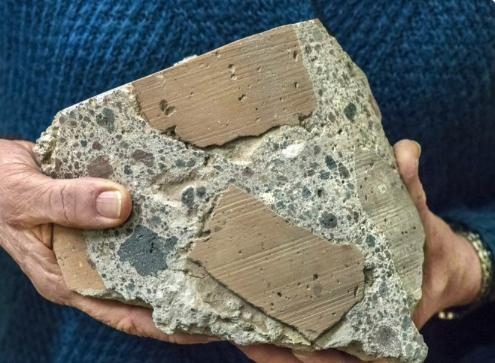
Archaeologists excavating a site in Pompeii have uncovered compelling evidence that illuminates the remarkable durability of ancient Roman buildings. Their findings suggest that a unique type of concrete used by the Romans could repair itself over time, a breakthrough that may provide valuable lessons for contemporary construction techniques. The research was published in the journal Nature Communications earlier this month and focuses on a construction site preserved under volcanic ash following the eruption of Mount Vesuvius in 79 AD.
The excavation site offers a rare glimpse into the construction methods of Roman builders. Instead of studying completed structures, researchers examined unfinished walls, materials, and tools, allowing them to observe the processes employed during concrete mixing. The discovery includes various functional spaces, such as rooms for residences, a bakery with ovens, and storage areas. Workers left everything behind when the volcano erupted, providing modern scientists with a unique opportunity to analyze ancient building techniques in detail.
Archaeologists identified the raw components of a 2,000-year-old concrete mixture, which has long intrigued historians and engineers alike. It was already known that the Romans utilized concrete to construct monumental buildings like the Colosseum and the Pantheon, many of which remain standing today. However, the exact reasons for the longevity of Roman concrete had not been fully understood until now.
Researchers discovered that Roman builders employed a method referred to as “hot mixing.” This technique involved adding quicklime directly to a mixture of water, volcanic ash, and rock. The chemical reaction generated heat during the preparation process, resulting in the formation of small white lumps known as lime clasts within the concrete. Previously, these lumps were thought to indicate poor mixing practices, but new findings reveal their crucial role in the concrete’s self-healing capabilities.
When cracks appeared in the concrete and water infiltrated the material, the lime clasts dissolved and reacted with the water to form calcium carbonate. This reaction enabled the concrete to seal the cracks, effectively allowing it to “heal” itself over time.
Admir Masic, a professor at the Massachusetts Institute of Technology and co-author of the study, described the excavation experience as akin to “traveling back in time.” He emphasized the significance of the site, which dates to over a century after the Romans began large-scale concrete production in the first century BC. Masic noted that the findings suggest advancements in Roman construction techniques that had not been previously documented, contrasting with earlier descriptions by the Roman architect Vitruvius.
The implications of this research extend beyond historical curiosity. Modern concrete typically lacks the self-healing properties demonstrated by its ancient counterpart. As a result, cracks in contemporary structures can lead to costly repairs and premature replacements of infrastructure, including bridges and roads. While Masic cautioned against directly replacing modern standards with ancient methods, he believes that the principles underlying Roman concrete could inspire engineers to develop stronger and longer-lasting materials. This approach could prove essential as governments worldwide aim to invest in infrastructure that endures and minimizes maintenance costs.
As the United States ramps up major infrastructure investments in 2025 under the administration of President Donald Trump, discoveries like this underscore the notion that innovation can stem from historical insights rather than solely from new technologies. The findings from Pompeii not only enhance our understanding of Roman engineering but also reveal that ancient builders had solutions that modern science is only beginning to grasp fully.