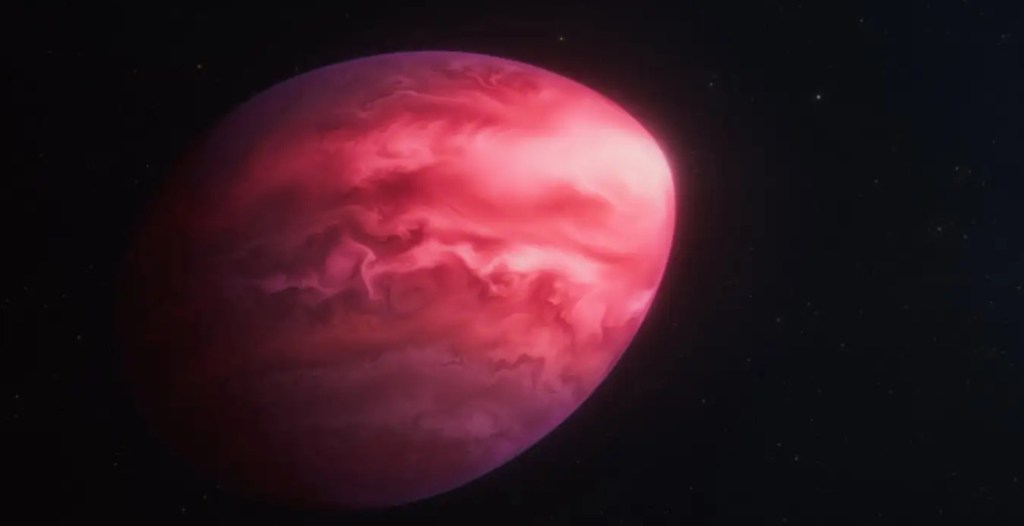
Astronomers have recently identified a planet that challenges existing models of planetary formation. Known as PSR J2322-2650b, this lemon-shaped planet is approximately the size of Jupiter and orbits a pulsar, the dense remnant of a star that has completed its life cycle. Its atmosphere is predominantly composed of carbon, leading researchers to question how such a planet could exist.
PSR J2322-2650b completes a full orbit around its pulsar every 7.8 hours, placing it in extremely close proximity to its host star. This closeness exposes the planet to intense high-energy radiation. Observations indicate that atmospheric temperatures on the dayside can reach around 3,700 degrees Fahrenheit, while the nightside cools to approximately 1,200 degrees Fahrenheit. The gravitational forces and extreme heat significantly distort the planet’s shape, resulting in its unique elongated form.
Unprecedented Atmospheric Composition
Using the James Webb Space Telescope, scientists conducted a detailed study of PSR J2322-2650b throughout its full orbit. They aimed to understand how light interacted with its atmosphere, but the results were unexpected. Instead of the typical mix of hydrogen, oxygen, and nitrogen found in gas giants, the planet’s atmospheric spectrum revealed a high concentration of carbon-based molecules. Signals from carbon chains, specifically C2 and C3, appeared prominently, while oxygen and nitrogen were notably scarce.
According to Michael Zhang, the lead author of the study, “The planet orbits a star that’s completely bizarre—the mass of the Sun, but the size of a city. This is a new type of planet atmosphere that nobody has ever seen before.” The ratios of carbon to other elements are striking; the carbon-to-oxygen ratio exceeds 100 to one, while the carbon-to-nitrogen ratio surpasses 10,000 to one. These figures are unprecedented, as no known planet around a typical star exhibits such extreme atmospheric characteristics.
Challenging Existing Theories
PSR J2322-2650b presents a significant challenge to current theories of planet formation, particularly those related to pulsars. Systems like this one are often referred to as “black widows,” where a pulsar gradually strips material from a companion star, typically leading to a more balanced elemental composition. The heavy carbon-rich atmosphere of PSR J2322-2650b suggests an unusual formation process that existing models cannot fully explain.
Researchers examined various theories, including the possibility of unique stellar chemistry or the influence of carbon-rich dust. However, none of these explanations accounted satisfactorily for the observations made by the James Webb Space Telescope.
The heating patterns on PSR J2322-2650b also deviate from those of typical hot Jupiters. Gamma rays penetrate more deeply into the atmosphere, creating wind patterns that shift heat westward rather than directly away from the pulsar. Consequently, the hottest region of the planet does not align with predictions based on current models.
As it stands, PSR J2322-2650b is an outlier in the universe of planetary science. While the James Webb Space Telescope has confirmed its existence and peculiar atmospheric characteristics, the question of how this unusual planet formed remains unanswered. The discovery offers a glimpse into the complexities of planetary systems and the potential for further exploration of worlds that defy conventional understanding.