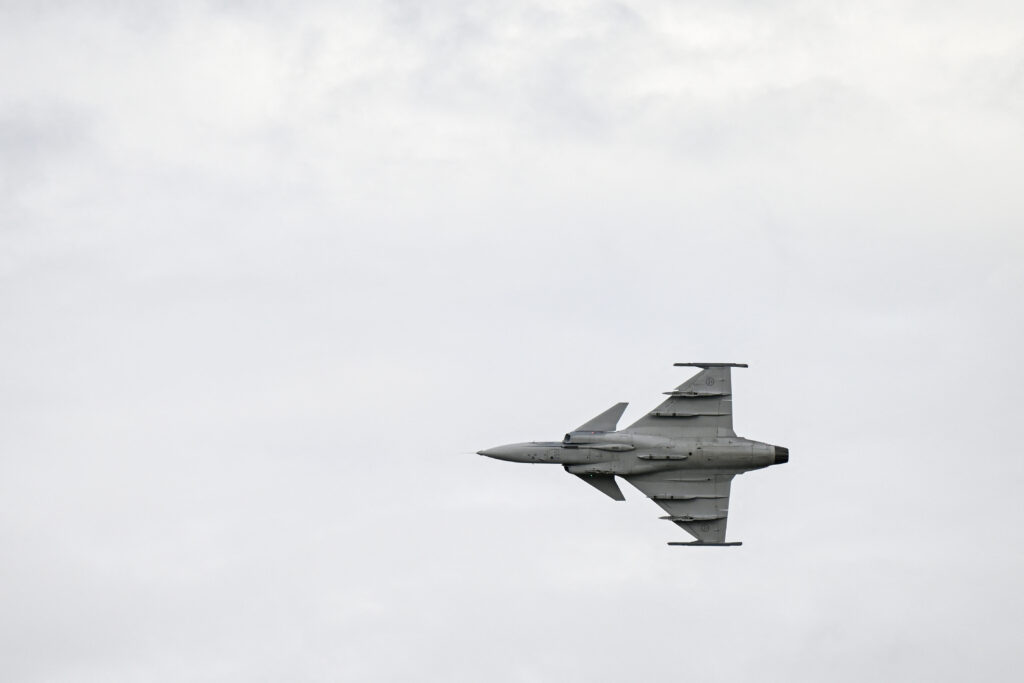
A Saab Gripen E-series fighter aircraft is seen in the sky over the airport of Linkoping, Sweden, as it is shown to the Ukrainian President during his visit on October 22, 2025. Ukrainian President Volodymyr Zelensky arrived in Sweden, where the two countries will make a "defence export" announcement, the Swedish government said. (Photo by Jonathan Nackstrand / AFP) (Photo by JONATHAN NACKSTRAND/AFP via Getty Images)
Sweden is set to enhance its military capabilities significantly with the integration of the German-made Taurus cruise missile onto its Gripen fighter aircraft. This advancement, announced by Maj. Gen. Jonas Wikman, the commander of the Swedish Air Force, will enable the country to conduct deep strikes well behind enemy lines sooner than initially planned.
In an interview with Defense News, Wikman stated, “We have reprioritized and done work to ensure that our industry, FMV, and the Air Force’s work on this overlaps as much as possible, resulting in the original timeline shifting left.” The FMV, Sweden’s defense materiel agency, had previously projected that the initial operational capability for the Taurus KEPD-350 missile on the Gripen C/D would not be achieved until 2028. While the specific date for integration remains undisclosed due to project sensitivity, the accelerated timeline reflects a strategic shift in Sweden’s defense posture.
The Taurus missile, developed by Taurus Systems GmbH, a joint venture between MBDA Deutschland and Saab, is designed to effectively neutralize hardened and deeply buried targets. It boasts a range exceeding 500 kilometers and can carry a warhead weighing 481 kilograms, which enhances Sweden’s offensive capabilities, previously absent from its military arsenal.
Wikman emphasized the significance of this development, calling it “a huge step” that will impact not only the operational capabilities of the Air Force but also its overall doctrine. “The capability itself is very important because we haven’t had any deep-strike or offensive counter-air capabilities before,” he noted. This transformation marks a shift from a defense-only strategy to one that incorporates offensive capabilities, reflecting modern military requirements.
Sweden’s collaboration with Germany has proven essential in advancing long-range offensive fire capabilities. Notably, Saab has previously showcased the Gripen with the Taurus missile, including static displays at defense exhibitions like the FIDAE defense fair in Chile in 2016. Despite these demonstrations, live-fire tests with the missile on the Gripen have yet to be conducted.
The Swedish approach to modernizing the Gripen is distinctive. Instead of a traditional mid-life update, the country integrates new capabilities on a rolling basis, with significant upgrades planned approximately every three years. This strategy is facilitated by Saab’s strong position as a national manufacturer, which allows for rapid adaptation to changing operational needs.
Wikman explained that two main factors enable this agile development. First, Saab’s control over the industry ecosystem allows for swift technological adaptations. Second, a recent overhaul of the avionics architecture in the Gripen E fighter has separated flight-safety-critical software from combat mission software. This separation simplifies the process of implementing quick upgrades to combat effectiveness, according to Saab engineers.
As Sweden prepares for this crucial enhancement to its military capabilities, the integration of the Taurus missile into the Gripen represents a significant evolution in its defense strategy, poised to reshape its operations in the years to come.