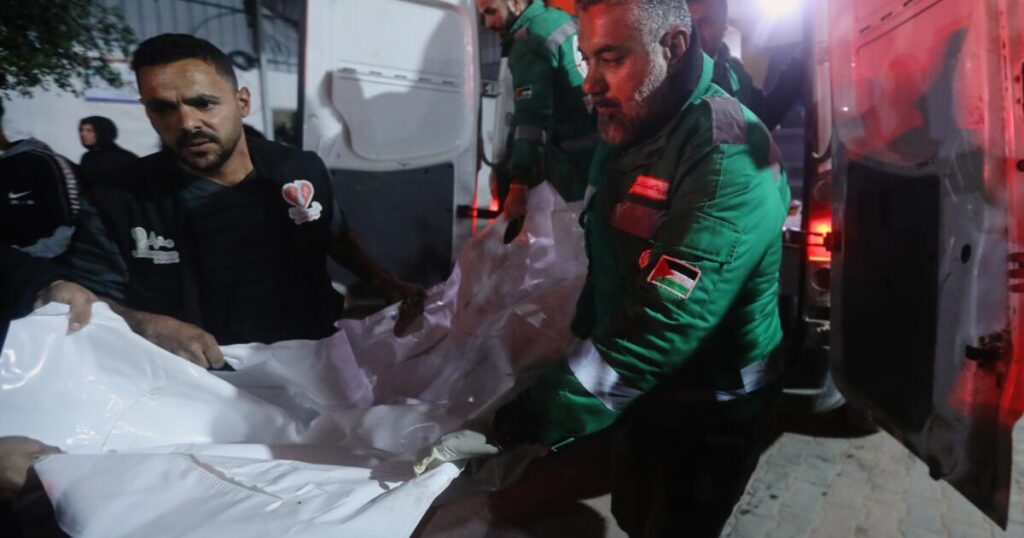
UPDATE: Israeli troops have fired across the ceasefire line in the northern Gaza Strip, resulting in the deaths of at least five Palestinians, including a baby, as reported by local hospital officials in Deir al-Balah on Friday.
The attack, which occurred in the Tuffah neighborhood of Gaza City, raises urgent concerns about the stability of the ongoing ceasefire between Israel and Hamas, which has been increasingly fragile in recent weeks. Rami Mhanna, managing director of Shifa Hospital, confirmed the casualties, highlighting the devastating impact on civilians amidst the conflict.
According to the Israeli military, troops identified “a number of suspicious individuals” linked to command structures west of the Yellow Line and subsequently launched fire at them. The military stated that it “regrets any harm to uninvolved individuals,” while the incident is currently under review.
This escalation comes as Steve Witkoff, President Trump’s envoy, prepares to host key Middle Eastern officials in Florida to mediate the Gaza ceasefire discussions. These talks aim to advance the ceasefire into its second, more complex phase. The initial phase began in October, following a devastating Hamas-led attack on Israel that resulted in approximately 1,200 fatalities.
The Health Ministry in Gaza reports that the ongoing war has claimed more than 70,660 Palestinian lives, with roughly half being women and children. This count is controversial, as it does not differentiate between militants and civilians. However, the ministry, operating under the Hamas-run government, maintains records considered reliable by the international community.
While the ceasefire has held for three months, its progress has been marred by accusations of violations from both sides. The next phase of the ceasefire negotiations is expected to address significant challenges, including the deployment of an international stabilization force, establishing a technocratic governing body for Gaza, disarming Hamas, and facilitating further Israeli troop withdrawals.
As the situation develops, the international community closely watches the impact of continued violence on civilians and the potential for renewed conflict. With the stakes higher than ever, updates on this evolving story will be crucial for understanding the ongoing humanitarian crisis in the region.