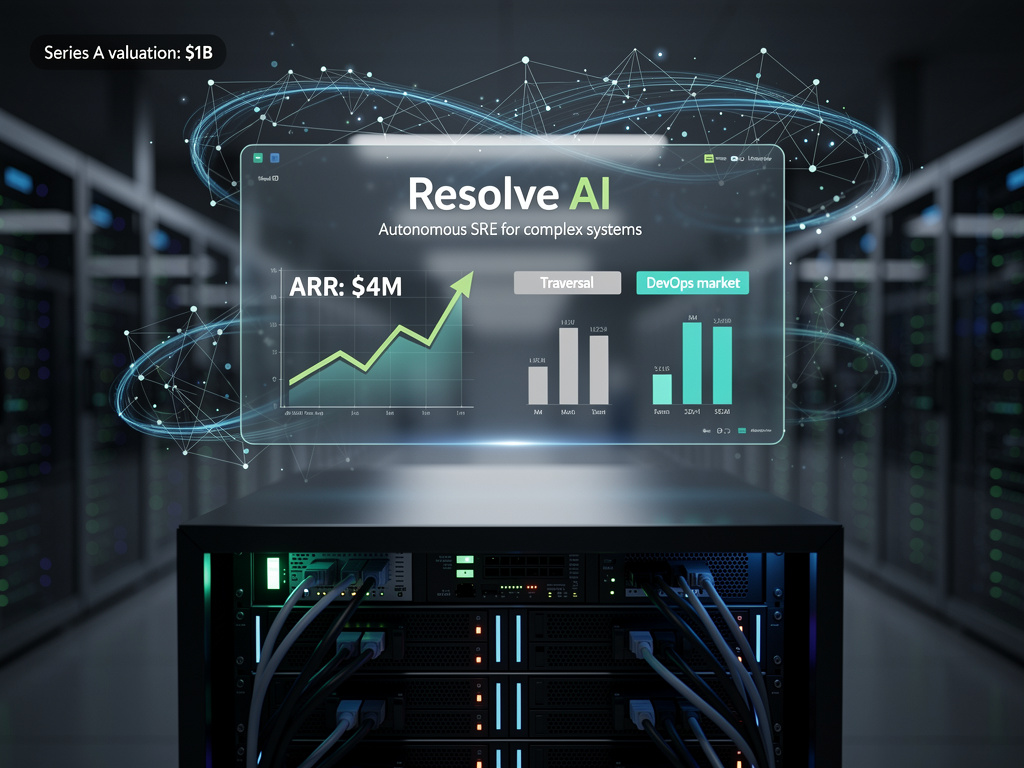
Resolve AI, a startup focused on automating site reliability engineering (SRE), has reached a significant milestone with a valuation of $1 billion following a recent Series A funding round led by Lightspeed Venture Partners. This achievement is notable for its rapid ascent to unicorn status, reflecting a growing investor interest in technologies designed to mitigate production outages in complex cloud environments.
The funding round, although undisclosed in total size, is reported to involve a multi-tranched structure that incorporates lower pricing for portions of the investment. This approach is increasingly common among high-profile AI ventures, allowing them to balance market enthusiasm with a cautious financial strategy. Sources familiar with the company’s finances indicate that Resolve AI currently generates an annual recurring revenue of approximately $4 million, showcasing its early traction in a competitive marketplace.
Founded less than two years ago by former Splunk executives Spiros Xanthos and Mayank Agarwal, Resolve AI leverages their extensive expertise in observability to deliver an autonomous SRE agent. This technology actively detects, diagnoses, and resolves issues in real time, addressing the increasing complexity faced by human SRE teams navigating microservices, Kubernetes clusters, and multi-cloud infrastructures.
Founders’ Background and Expertise
Xanthos, the former general manager and senior vice president of observability at Splunk, and Agarwal, who served as chief architect for observability products, trace their collaboration back to their graduate studies at the University of Illinois Urbana-Champaign. Their previous startup, Omnition, a tracing platform, was acquired by Splunk in 2019, providing them with valuable experience in scaling observability solutions for large enterprises.
The team at Resolve AI includes contributions from early engineers involved with Kubernetes at Google and experts from various sectors. In a post on Hacker News, the company emphasized their extensive background, stating, “Our team at Resolve AI comes with a wealth of experience in this space.” This expertise positions them well to tackle the pressing challenges within site reliability engineering.
Addressing Industry Challenges
The demand for autonomous operations is escalating as companies face a shortage of qualified SRE professionals. Outages can cost organizations millions of dollars every hour, making the need for effective solutions critical. Resolve AI’s platform aims to significantly reduce downtime and operational costs, allowing engineers to focus more on innovation rather than routine maintenance tasks.
TechCrunch highlighted the startup’s efforts by stating, “Resolve AI automates this process by autonomously identifying, diagnosing, and resolving production issues in real time.” This capability is expected to slash mean time to resolution (MTTR) and alleviate the operational toil traditionally associated with incident management.
Prior to this latest funding round, Resolve AI successfully raised $35 million in seed funding in October 2024, led by Greylock, with notable investors including Fei-Fei Li of World Labs and Jeff Dean from Google DeepMind. This initial capital has been instrumental in developing their product and establishing the company as a leader in AI-driven operations.
As Resolve AI enters a competitive landscape that includes startups like Traversal, which recently secured $48 million in Series A funding, the focus remains on capturing a share of the over $20 billion DevOps market. Current leaders in monitoring solutions, such as PagerDuty and Datadog, have yet to fully automate remediation processes, leaving ample opportunity for innovation.
Investor interest in Resolve AI aligns with broader trends in the technology sector, particularly as Lightspeed recently announced a substantial $9 billion fundraising initiative dedicated to AI investments. The firm cited Resolve’s traction amidst ongoing shifts in enterprise AI as a significant factor in their decision to lead this funding round.
The integration of advanced AI with established observability practices represents a critical innovation for Resolve. The company’s autonomous agent is designed to handle severe error events (SEVs) by leveraging large-scale data pipelines, a strategy grounded in the founders’ previous experiences.
Despite the promising outlook, challenges remain. Resolve must prove its reliability at hyperscale volumes, navigate complex data privacy issues in AI diagnostics, and compete effectively against established open-source rivals. Nevertheless, Xanthos and Agarwal’s track record positions Resolve well to address the demands of a sector where operational inefficiencies consume up to 50% of engineering time, according to industry studies.
The ascent of Resolve AI underscores a shift in the AI landscape from chatbots to infrastructure-focused solutions, where significant cost savings can be realized. With the backing of influential seed investors, new partnerships with major cloud providers like AWS, Google Cloud, and Azure are anticipated as the company continues to secure its place as a leader in the automation of site reliability engineering.