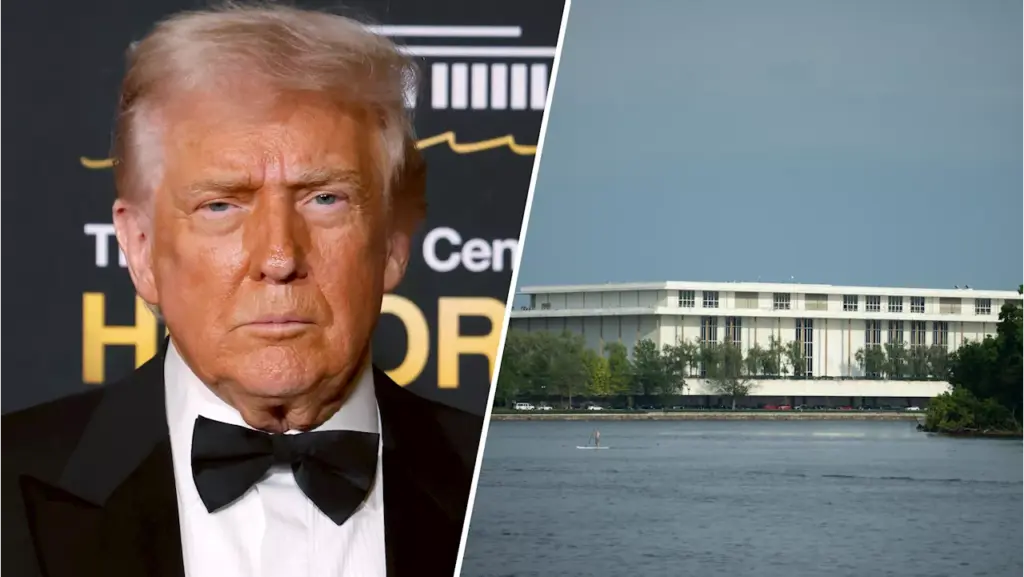
The decision by the Kennedy Center’s board to rename the institution as the Trump-Kennedy Center has sparked significant legal challenges. This move not only faces opposition from within the board itself but also encounters restrictions rooted in the original legislation that established the center. According to this law, any alteration to the name requires Congressional approval, complicating the process significantly.
On Thursday, a spokesperson for the Kennedy Center and White House Press Secretary Karoline Leavitt confirmed that the board had voted to change its name to include Donald Trump’s name. While Leavitt characterized the board’s decision as unanimous, Rep. Joyce Beatty, a Democrat from Ohio and an ex-officio member of the board, publicly disputed this claim, stating, “For the record, this was not unanimous. I was muted on the call and not allowed to speak or voice my opposition to this move.” This internal discord raises questions about the legitimacy of the vote.
The original laws governing the Kennedy Center were enacted during the administrations of Presidents Dwight D. Eisenhower, John F. Kennedy, and Lyndon B. Johnson. These laws specifically prohibit any renaming of the center, meaning that Congressional action would be necessary to proceed with the proposed change. Such legislative maneuvering is uncertain, as it is unclear whether there would be sufficient support in the Senate, where a minimum of 60 votes would be required.
Concerns over the name change extend beyond legislative hurdles. Family members of the late president, including Joseph Kennedy III, have voiced strong objections. Kennedy III, a grandnephew of John F. Kennedy, asserted, “The Kennedy Center is a living memorial to a fallen president and named for President Kennedy by federal law. It can no sooner be renamed than can someone rename the Lincoln Memorial.”
In a broader context, the push to rename the center also reflects tensions within the cultural landscape during Trump’s presidency. Following his return to Washington in January 2023, Trump quickly moved to reshape the Kennedy Center’s leadership, appointing board members who aligned with his views and criticizing previous management for what he described as “woke” programming.
Deborah Rutter, the former president of the Kennedy Center who was dismissed under Trump’s leadership, responded to the allegations of financial mismanagement by stating, “When I left, the Kennedy Center was fiscally sound.” Her ousting, coupled with the resignations of prominent artists and performers such as Issa Rae and Renée Fleming, indicates a growing rift in the arts community regarding the center’s direction.
The fallout from the board’s decision continues to unfold. As Trump alluded to a “big event” at the Trump-Kennedy Center during a recent appearance, his remarks drew laughter from the audience, highlighting the polarized reception of the name change. Maria Shriver, a niece of John F. Kennedy, referred to the legislative proposals to rename the center as “insane,” expressing her frustration over the motivations behind such actions.
As discussions about the Kennedy Center evolve, the implications of this proposed renaming extend beyond mere titles. The legacy of John F. Kennedy as a revered figure in American history remains at the forefront of this contentious debate. Observers are closely watching how this situation develops and what it may mean for the future of the Kennedy Center as a cultural institution.