UPDATE: Republican Senator Ted Cruz has issued an urgent warning that he will block funding to keep the federal government open after the end of January 2024 unless crucial reforms on military flight regulations are approved. This demand comes in response to the tragic crash that claimed 67 lives when an airliner collided with an Army helicopter over Washington, D.C.
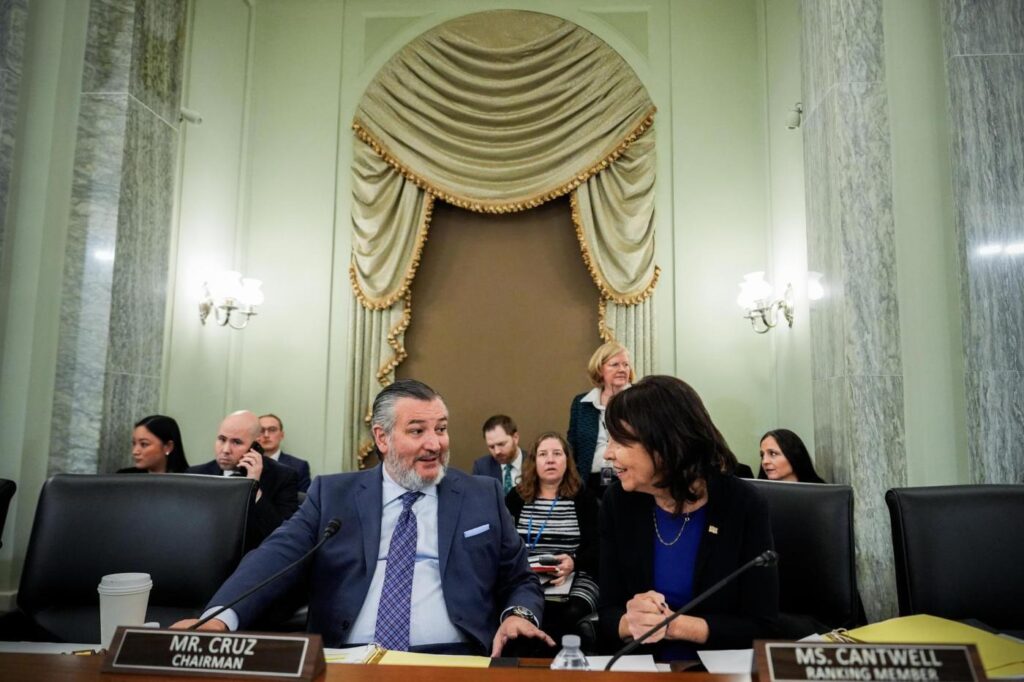
During a press conference on Monday, Cruz and Democratic Senator Maria Cantwell joined with victims’ families to call on Congress to remove provisions from a massive defense bill that would allow military aircraft to operate without broadcasting their precise locations. This exemption, they argue, could lead to further aviation disasters like the one that occurred on January 29.
Cruz emphasized that if the defense bill is passed with these dangerous provisions intact, he will resort to obstructing government funding. “The special carve-out was exactly what caused the January 29th crash,” Cruz stated, highlighting the need for immediate action to enhance aviation safety.
The controversial defense bill, which is currently under consideration, includes a provision allowing military helicopters to operate without the critical ADS-B system that broadcasts their locations. The FAA mandated this requirement for all aircraft in March 2023 to improve safety in crowded airspace, particularly around the nation’s capital.
As the situation unfolds, it’s uncertain whether Republican leadership will permit amendments to the defense bill that could delay military pay raises and other vital provisions. Cruz’s proposed legislation to enforce stricter flight safety measures has garnered support from key stakeholders, including the White House, the NTSB, and various transportation unions.
The urgency surrounding this issue has intensified following sharp criticism from the NTSB and other officials, who have raised concerns about the safety implications of the newly proposed helicopter regulations. Cruz and Cantwell stated they only became aware of these provisions after congressional leaders finalized the bill last week, prompting their immediate objections.
Families affected by the crash have voiced their alarm, insisting that weakening these safety measures could lead to further tragedies. “Our families know the consequences of systemic failures, and we cannot accept a policy change that makes our skies less safe,” they declared in a statement.
The NTSB is expected to release its final report on the crash sometime next year, but investigators have already highlighted multiple near misses at Ronald Reagan National Airport prior to the incident. The proposed reforms aim to prevent such occurrences and restore confidence in aviation safety.
As developments continue to unfold, all eyes are on Congress to see if they will heed the call for stricter safety regulations before the looming deadline at the end of January. The stakes are high, and the potential for further loss looms large if action is not taken swiftly.