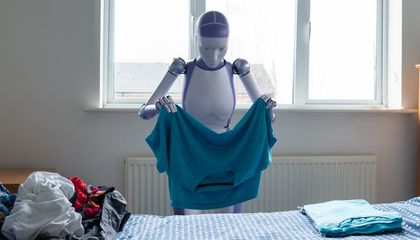
The quest to develop robots that can fold laundry is proving to be a significant challenge, despite advancements in technology. While the fictional Rosie the Robot from “The Jetsons” showcased a future where household chores are effortlessly managed by machines, current robotics struggle with the seemingly simple task of folding clothes. This challenge stems from the complex nature of fabric manipulation, which requires an understanding of three-dimensional object behavior.
Folding laundry may appear mundane, yet it encompasses a multitude of variables that robots must navigate. The act involves various fabric types, each presenting unique folding challenges. For instance, the way a T-shirt lands in a laundry basket can differ significantly each time, complicating the folding process. David Held, a robotics researcher at Carnegie Mellon University, highlights that it is not the fabric itself that poses the challenge, but rather the countless ways it can be crumpled and the diverse clothing items that exist.
Current robotic systems primarily rely on a “pick and place” method for laundry folding. This strategy involves using a pre-defined motion to manipulate fabric, which often leads to unsatisfactory results. The robots lack the sensory feedback that humans possess, which allows people to intuitively understand how to handle different fabrics. As Danica Kragic, a computer scientist at KTH Royal Institute of Technology, notes, “Humans have flexible hands covered by skin that can sense temperature, texture, whether something is wet or dry.”
Recent developments, such as the AdaFold algorithm, aim to enhance robotic folding capabilities. Unlike traditional strategies, AdaFold adjusts its folding path in real-time, responding to changes in fabric shape and minimizing crumpling. This adaptability addresses one of the significant limitations of existing robotic systems, which struggle to cope with unexpected challenges during the folding process.
In a study conducted in 2024, the performance of various folding methods was evaluated using a metric called Intersection over Union (IoU), which measures the overlap of the folded material. The traditional pick and place method achieved an IoU score of only 0.41, indicating a subpar folding result. In contrast, AdaFold demonstrated a much higher score of 0.83, showcasing its ability to adjust and improve folding accuracy.
The progress in robotic folding extends beyond just laundry. Researchers are exploring how these advancements can lead to the development of robots capable of navigating the complexities of daily life. Alberta Longhini, a co-creator of AdaFold, emphasizes the importance of robots being able to recognize and adapt to real-time changes, much like humans do. “For robots, this is still complex,” she states.
To aid in the training of robots, researchers have developed datasets such as ClothesNet, which contains 4,400 simulated three-dimensional clothing items. This resource provides a more realistic representation of clothing features, allowing robots to learn more effectively. Despite these improvements, significant challenges remain.
Roboticists continue to face the intricate task of enabling robots to manipulate fabrics with the same ease and intuition that humans possess. Until these challenges are resolved, the dream of fully autonomous laundry folding remains out of reach. As the field of robotics evolves, the vision of a household where chores are managed by intelligent machines may yet become a reality, but for now, the laundry pile remains a human domain.