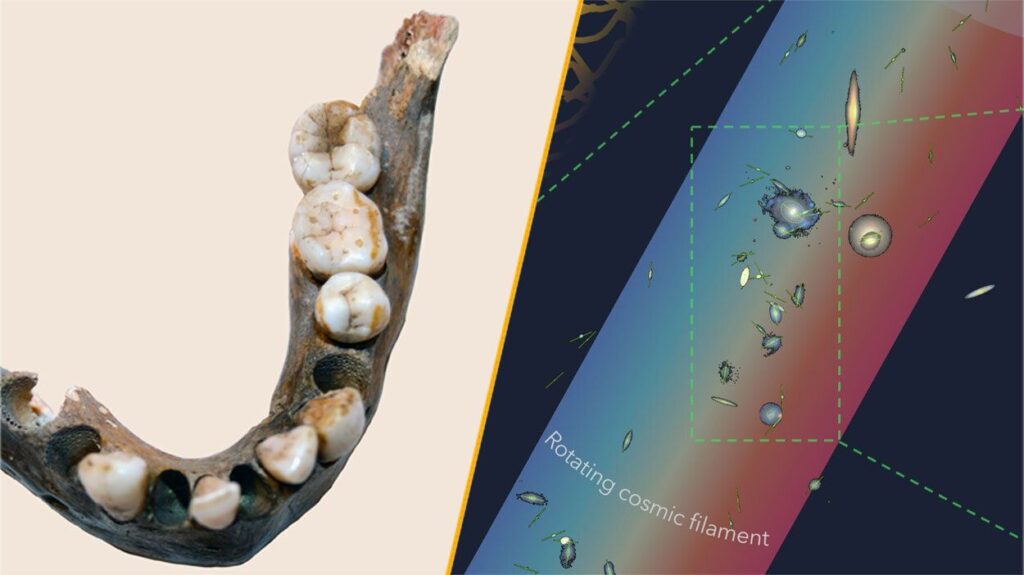
This week, a series of groundbreaking discoveries across various scientific fields captured the global spotlight. Researchers unveiled the largest spinning structure in the universe, studied a human population isolated for 100,000 years, and developed innovative methods to extract water from the atmosphere.
Massive Spinning Structure Discovered
Astronomers announced the discovery of the largest known spinning object, located approximately 140 million light-years away. This colossal rotating filament is wider than the Milky Way and connects a chain of 14 galaxies. The filament spins at an impressive speed of around 68 miles per second (110 kilometers per second). Such findings significantly enhance our understanding of cosmic structures and the dynamics of galaxy formation.
Ancient Human Population Revealed
In southern Africa, a team of researchers has identified a human population that remained genetically isolated for an extraordinary 100,000 years. The study focused on skeletons discovered south of the Limpopo River, which flows from South Africa into Mozambique. Remarkably, the remains, dating back more than 1,400 years, displayed a genetic makeup sharply distinct from that of modern humans. According to the researchers, these individuals represent “an extreme end of human genetic variation.”
Further discoveries in archaeology also added to this week’s scientific revelations. In China, archaeologists unearthed a pit filled with skulls outside a 4,000-year-old city. This finding is particularly puzzling because nearly all the skulls belonged to males, deviating from typical human sacrificial patterns found in similar sites nearby. In Greece, an elaborate tomb dating back 2,700 years contained the remains of a woman adorned with an upside-down crown, raising questions about ancient burial practices.
Innovative Water Extraction Technology
In a notable advancement, engineers at the Massachusetts Institute of Technology (MIT) have developed a method to generate drinking water from air using sound waves. This innovative approach can produce water in minutes, significantly improving efficiency compared to traditional evaporation systems. The new technique, which is 45 times more efficient than previous methods, could be a game-changer, especially in dry regions where water scarcity is a pressing issue.
Despite its promise, the device requires a power source. Researchers believe they can address this by integrating solar cells to power the extraction process, making it a sustainable solution for water supply challenges.
Environmental and Historical Insights
On a related note, a long-term environmental project in China known as the Great Green Wall has produced unintended consequences. Originally aimed at combating desertification through extensive tree planting, the initiative has altered rainfall and evaporation patterns, leading to decreased water levels in several densely populated areas. This analysis highlights the complexities of large-scale environmental interventions.
Additionally, a study suggests that the record for the world’s hottest temperature, set in Death Valley in 1913, may have stemmed from human error, prompting a reevaluation of climate data accuracy. Meanwhile, in Europe, the potential collapse of a key Atlantic current raises concerns about future drought conditions across the continent.
As researchers continue to explore the cosmos, they have also focused on the interstellar comet 3I/ATLAS. Observations from the Joan Oró Telescope in northeastern Spain revealed that the comet is exhibiting signs of “ice volcanoes,” with spiral jets erupting from its surface. This discovery not only enhances our understanding of such celestial bodies but also draws parallels to other objects within our solar system.
In summary, this week’s scientific developments span ancient human history, cosmic discoveries, and innovative technologies addressing contemporary challenges. The ongoing exploration of our planet and beyond continues to unveil the complexities and wonders of existence, inspiring curiosity and advancing knowledge.