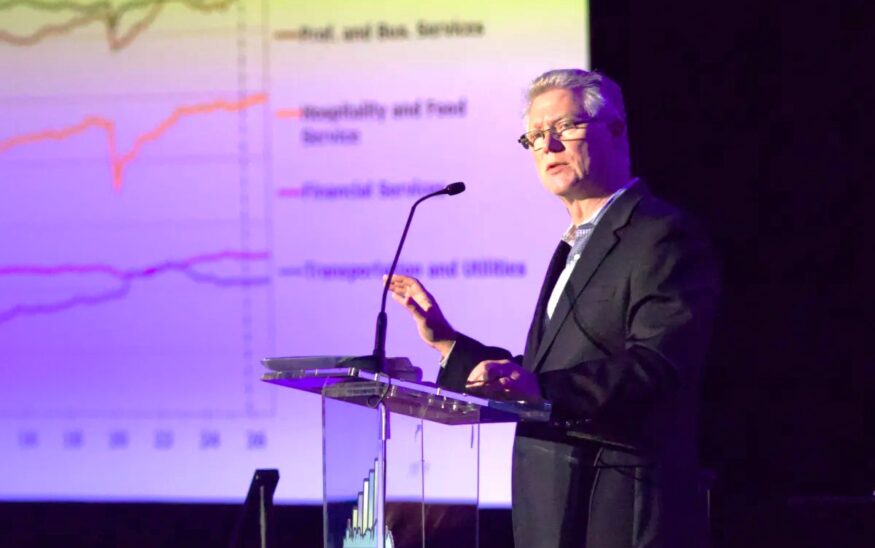
Tulsa’s job market is experiencing significant growth, surpassing that of Oklahoma City, according to insights shared at the Tulsa Regional Chamber’s annual State of the Economy meeting. Economists Mark Snead, president of RegionTrack, and Joe Seydl from JPMorgan highlighted the city’s trajectory as a positive indicator for both local and state economic health.
During the meeting held on March 15, 2024, Snead emphasized that the recent job growth reflects a broader trend benefiting the state, with Oklahoma ranking 14th among the 50 states in job growth over the past year. “The past 18 to 24 months, Tulsa’s growth has really accelerated, and Oklahoma City’s slowed a bit,” he stated, underscoring the importance of both metropolitan areas thriving simultaneously.
Economic Predictions and Changing Job Landscapes
The discussion also touched on the impact of artificial intelligence (AI) on the job market. Snead reassured attendees that while AI will transform existing roles, it will not eliminate jobs outright. Instead, those entering the workforce will need to develop technological skills to remain competitive. “We’re slicing up tech workers and putting their tasks into thousands and millions of other jobs,” he noted, suggesting that the integration of technology will enhance creativity across various sectors.
Seydl, who recently relocated from New York to Dallas, pointed out that Tulsa’s affordable housing market is attracting new residents. He remarked on the national housing landscape, indicating that median home prices have become increasingly unaffordable for first-time buyers. “The average age for first-time homebuyers has reached an all-time high of 40 years old,” he said, attributing this trend to the unaffordability largely seen in coastal states such as California and Florida. “Over time, it’s going to really benefit states like Oklahoma and Texas,” he added, predicting continued population growth as younger individuals seek more affordable living conditions.
Future Developments and Market Adaptations
Both economists anticipate that tariffs imposed by the Trump administration on foreign goods will remain in place, yet they express confidence in the U.S. economy’s resilience. Seydl highlighted the exemptions for key sectors, particularly technology and semiconductors, which are essential to the AI revolution. “That sector has been such a critical component of U.S. growth this year,” he remarked.
Northeastern Oklahoma is set to benefit from this growth, with several major data centers planned for construction over the coming years. Snead predicts that both Tulsa and the broader state will match or slightly exceed national job growth rates in the near future. He also forecasted that Oklahoma City will catch up to Tulsa regarding job growth rates in the upcoming year.
The insights shared at this event paint a promising picture for Tulsa’s economy, suggesting that the city is well-positioned for future growth and opportunities as it navigates the evolving job market landscape. As Tulsa continues to attract new residents and businesses, it solidifies its reputation as an appealing destination for work and life in the region.