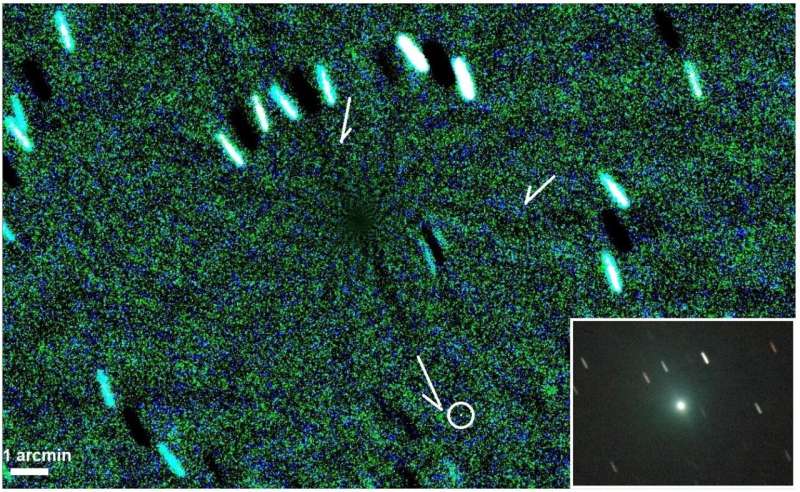
A recent study of the interstellar comet 3I/ATLAS suggests that it may be covered in erupting icy structures known as cryovolcanoes. This finding could significantly alter our understanding of how comets form. Researchers tracked the comet from July to November 2025 as it approached the sun, offering a unique opportunity to examine an object that originated from another star system.
Insights from Cryovolcanism
This comet is particularly valuable for scientific study because it remains pristine, having never come close enough to a star to undergo heating or alteration by radiation. Therefore, it retains characteristics similar to those present billions of years ago during its formation.
In their study published on the arXiv preprint server, the research team analyzed photometric observations that revealed a significant increase in the comet’s brightness when it reached approximately 2.5 astronomical units from the sun. This increase was not a brief spike but a sustained brightening, interpreted by scientists as an activation of the comet’s water-ice layer across its surface.
The sustained activity is likely due to cryovolcanism, which is the volcanic eruption of ice. Unlike many comets in our solar system, 3I/ATLAS lacks a protective dust mantle, allowing for this global activation to occur without obstruction.
Composition and Implications
Through analysis of the light reflected from the comet’s surface, researchers found it matched the spectrum of a rare type of meteorite known as carbonaceous chondrite. These meteorites are rich in metals such as iron and nickel. The team posits that Comet 3I/ATLAS likely shares this metal-rich composition, which could explain its intense volcanic activity.
As the surface of the comet warms and the ice transitions to water, it may corrode fine metal grains within the body. This chemical reaction can release energy and gases, including carbon dioxide, which sustain the cryovolcanic activity.
This discovery challenges existing models of comet formation, which typically describe them as bodies composed mainly of ice, rock, and low metal concentrations. The new findings indicate a broader diversity in the processes that lead to the formation of comets. The authors of the study remarked, “Interstellar visitors like 3I/ATLAS continue to challenge and refine our understanding of planetary-system formation and the chemical evolution of small bodies.”
This research was conducted by a team led by Josep M. Trigo-Rodríguez, with contributions from Paul Arnold, Gaby Clark, and Robert Egan. The study underscores the potential for interstellar objects to reshape our comprehension of cosmic phenomena.
As science continues to explore the mysteries of the universe, discoveries like those surrounding Comet 3I/ATLAS serve as vital pieces in the puzzle of understanding the origins and evolution of celestial bodies.